Measurements in the kitchen: A complete guide to ergonomics and volume
Have you ever held a handwritten recipe from the 1950s and realized that a "cup" doesn't match your modern measuring set? Small margins of error can quickly turn a passionate baking session into a failure, just as a countertop that deviates from the ergonomic standard of 90 centimeters can cause noticeable back pain after only a short period of work. We understand that the kitchen is the foundation of the home and that every millimeter counts when you choose to invest in durable materials and genuine craftsmanship. Having full control over the correct measurements in the kitchen is the hidden key to creating a space where both ergonomics and aesthetics work together in timeless harmony.
In this guide, you will learn everything about the most important measurements, from precise volume conversions for your recipes to the technical standard dimensions required to plan an efficient work triangle. We provide you with the tools and expertise needed to order custom-made wooden kitchens with full confidence, without worrying about costly misorders. By combining technical precision with a deep respect for the natural properties of wood, we ensure that your kitchen planning becomes a long-term investment in both quality of life and beauty.
Key Takeaways
- Learn to navigate between spice measures and liters with precision to succeed with both everyday cooking and advanced baking.
- Optimize your workflow by understanding how correct kitchen measurements and the classic work triangle create an ergonomic and comfortable environment.
- Get full control over standard widths for cabinet carcasses and learn the technique for measuring your existing kitchen doors for a sustainable update.
- Discover how to easily convert volume to weight for ingredients like flour and butter, ensuring a perfect result every time.
- Explore the benefits of millimeter-precise wooden kitchens in oak and walnut when standard measurements are not enough to realize your unique vision.
Volume Measurements in the Kitchen: From Spice Measures to Liters
A beautiful kitchen is about balancing aesthetics and function. Just as the choice of a solid oak floor requires precision during installation, success at the stove requires a deep understanding of correct proportions. Mastering various kitchen measurements is fundamental to transforming raw ingredients into a culinary experience. In Sweden, we have a long tradition of standardized measurement systems that simplify everyday life, but the difference between a successful soufflé and a failure often lies in the details.
Precision is particularly crucial in baking, where chemical reactions control the final result. A tablespoon too much flour can make the dough heavy, while cooking often allows for a more intuitive approach. Historically, Swedish measurements were standardized in the 1970s to create uniformity in homes. Before that, undefined terms like "a cup of coffee" or "a pinch" were often used, creating uncertainty. Today, the Swedish kitchen is based on a logical decimal system where volume measurements in the kitchen are based on milliliters and deciliters.
Swedish Standard Measurements and their Milliliters
- Spice measure (krm) = 1 ml: This is the smallest standard measurement. It is primarily used for potent flavorings like cayenne pepper or saffron, where a slight overdose dominates the entire dish.
- Teaspoon (tsk) = 5 ml and Tablespoon (msk) = 15 ml: A common mistake is to use regular eating utensils. A modern design teaspoon rarely holds exactly 5 ml. To achieve artisanal quality, you should always use calibrated measuring sets.
- Deciliter (dl) = 100 ml: This is the cornerstone of Swedish recipes. When measuring dry ingredients like flour, it is important not to pack the measure; instead, pour the flour into the deciliter measure to avoid adding too much.
International Measurements: Cups and Ounces
As we are inspired by global recipes, we often encounter American units. Translating a "cup" is not always straightforward as there are different standards. A US Legal Cup is equivalent to 240 ml, while a Metric Cup, used in Australia and Canada, is exactly 250 ml. This 10 ml difference may seem insignificant, but in complex recipes, the margin of error quickly accumulates.
For those seeking absolute perfection, the digital scale is the kitchen's best friend. Volume measurements can vary depending on how tightly you pack the ingredient, but the weight remains the same. Weighing ingredients provides an accuracy that reflects the meticulousness we apply when choosing materials for the home. By understanding the interplay between volume and weight, you ensure that your kitchen measurements always deliver a result characterized by quality and finesse.
Ergonomic Measurements in the Kitchen: Planning for Comfort
Planning the right kitchen measurements is about more than just millimeters. It's about how your body feels after an evening at the stove and how the flow in the room is perceived. For decades, 90 cm has been the golden standard for work height in Sweden. However, this figure is a compromise. For a person 185 cm tall, 90 cm can cause back pain, while for someone 160 cm tall, it can feel strenuous on the shoulders. A well-thought-out work triangle, the distance between the sink, stove, and refrigerator, forms the foundation of a functional daily life. The sum of these three sides should be between 400 and 800 cm to create an efficient flow without unnecessary steps.
Academic studies on Ergonomic standard measurements in the kitchen show that many of our current norms are based on historical data that do not always reflect today's population. Today, a more personal adaptation is required to achieve true ergonomics. Electrical outlets should be placed 60 to 120 cm apart along the work surface, strategically positioned about 10 to 20 cm above the countertop. This reduces the risk of tangled cords for appliances like coffee makers and blenders, while lighting under the wall cabinets should be directed to minimize shadows over the cutting board.
Work Height and Countertop Dimensions
Your ideal work height is calculated by measuring the distance from the floor to your bent elbow and then subtracting 15 cm. If your elbow is 110 cm up, your counter should be 95 cm high to spare your back. The standard depth of base cabinets is 60 cm, but we see a growing trend towards 70 cm deep countertops. This not only provides 15 percent more workspace but also creates space for plumbing behind the cabinets without encroaching on drawer space. In an exclusive wooden kitchen, the countertop thickness also plays a crucial aesthetic role; a solid slab of 30 or 40 mm conveys a weight and craftsmanship that thinner materials often lack.
Distances and Movement Areas
Precision in planning is especially required around kitchen islands and passages. The minimum recommended distance between a kitchen island and the opposing cabinet wall is 120 cm. This measurement allows two people to pass each other unhindered, or one person to stand at the stove while another empties the dishwasher behind. The height between the countertop and wall cabinets should be at least 50 cm. If the distance is shorter, you risk hitting your head when working, and if it's higher, the top shelves become difficult to reach for most people. To fully open the dishwasher and still move freely, a clear space of at least 110 cm in front of the machine is required. By respecting these kitchen measurements, you create an environment where movement feels natural and free.
If you want to delve deeper into how material selection and ergonomics interact, you can explore our solutions for custom interior details that elevate the entire room's atmosphere and function.
Measurements for Kitchen Doors and Cabinet Carcasses
Precision is the backbone of a beautiful kitchen. When we work with living and solid materials, correct kitchen measurements become an absolute prerequisite for craftsmanship to be fully appreciated. Most modern Scandinavian kitchens are based on a modular system where standard widths follow even intervals of 20, 40, 60, and 80 cm. This standardization facilitates planning, but in the meeting between joinery and the room's unique conditions, a keen eye for detail is required.
Working with solid wood implies an understanding that the material breathes. Millimeter precision is therefore not something that can be compromised. A door that is only two millimeters too wide can disrupt the entire visual harmony of a cabinet row or, in the worst case, hit adjacent fronts when opening. If you plan to upgrade your existing carcasses with new kitchen doors in real wood, the process always begins with careful documentation of the existing measurements.
Since Swedish homes rarely have perfectly straight angles or perfectly even walls, filler strips become your best friend. These are used to fill the gap between the last cabinet module and the wall. A well-fitted filler strip conceals unevenness and gives the kitchen that built-in feel characteristic of high-quality craftsmanship. Without these small but important parts, drawers and doors risk getting stuck against door frames or uneven corners.
Measuring for New Kitchen Doors
When ordering new fronts, it is safest to measure the back of your current doors. The front often has beveled edges or profiles that can make it difficult to get an exact measurement. Follow these steps for a successful result:
- Width and height: Always measure in millimeters. Standard measurements for a 60-door are often 597 mm to create a necessary distance between the fronts.
- Hinge placement: Measure from the top and bottom edge of the door to the center of the drilled hole for the hinge. Common measurements are 100 mm or 128 mm.
- Corner base cabinets: Be extra vigilant in corners. Here, specific measurements are often required for the doors to open without colliding with each other, especially if you have protruding handles.
Tall Cabinets and Wall Cabinets
Tall cabinets define the kitchen's vertical lines and are usually available in heights of 195, 212, or 225 cm. To create a timeless and seamless aesthetic, we recommend using a ceiling connection. This means filling the space between the top edge of the cabinet and the ceiling with a trim or filler strip, which eliminates dust-collecting surfaces and gives the room an architectural gravitas.
The depth of wall cabinets is another critical factor for ergonomics. Standard depth is often around 32 to 35 cm including the door. This measurement is carefully calculated so that you have full visibility over the worktop without risking hitting your head when leaning forward. By keeping wall cabinets shallower than base cabinets, which are usually 60 cm deep, an airy and functional work environment is created where your choice of kitchen measurements directly affects your daily cooking pleasure.

Conversion Table: Weights and Volumes
Precision is the foundation of all successful craftsmanship, whether it's installing timeless wood flooring or succeeding with a complex shortcrust pastry. Understanding how different kitchen measurements relate to each other is crucial for achieving that perfect balance in taste and texture. A deciliter is rarely just a deciliter; the density of ingredients changes everything when we go from volume to weight.
The Weight of Common Ingredients
When baking, the scale is your best friend. Wheat flour is one of the most misunderstood measurements; a deciliter weighs about 60 grams if poured lightly. If you instead pack the flour by scooping directly with the measure, the weight can rise to over 75 grams, making the baked good dry and dense. Granulated sugar is more predictable and consistently lands at around 85 grams per deciliter.
- Wheat flour: 1 dl = approx. 60g (pour the flour, never pack it).
- Granulated sugar: 1 dl = approx. 85g.
- Powdered sugar: 1 dl = approx. 60g.
- Liquid honey and syrup: 1 dl = approx. 140g (their high density means they weigh significantly more than water).
- Butter: 1 tbsp = approx. 15g; 1 dl = approx. 95g.
Wood's Natural Movements in the Kitchen Environment
It's not just the ingredients that are affected by the surroundings. Choosing solid wood for fixed kitchen furnishings or details means working with a living material. Just as flour can absorb moisture and change volume, wood reacts to the humidity in the room. During the humid summer months, the wood expands slightly, while the dry winter air causes it to contract. These natural dimensional changes require technical expertise during installation to ensure that the kitchen's aesthetics and function remain intact through all seasons.
Oven Temperatures and Measurements
Many international recipes use Fahrenheit, which can cause confusion at the stove. A simple rule of thumb is that 350°F corresponds to approximately 175°C, while 400°F is close to 200°C. When using a convection oven, you should generally lower the temperature by 20 to 25 degrees compared to a conventional oven to avoid the surface burning before the center is cooked.
Regarding equipment, the standard measurement for a Swedish coffee cup is 1.5 deciliters, which often differs from international "cups" which are usually around 2.4 deciliters. A standard baking sheet for a Swedish household oven typically measures around 38x42 centimeters, while a roasting pan has higher edges to accommodate liquid batters and roasts. Keeping track of these kitchen measurements facilitates scaling up recipes or adapting them to your specific equipment.
Custom Wooden Kitchens: When Standard Isn't Enough
Standard measurements are all well and good, but a home with character rarely follows a straight line. The traditional kitchen industry is based on 60-centimeter modules, which often results in compromises and dead spaces hidden behind wide filler strips. At Indoor Wood, we view the room as a whole where the furniture is adapted to the architecture, not the other way around. By working with millimeter precision in solid walnut and oak, we create a seamless transition between wall and interior. It's about maximizing the potential of every square meter and letting the natural grain of the wood run undisturbed across the fronts.
The precision of your kitchen measurements determines not only aesthetics but also durability. A built-in kitchen that rests exactly on its base is subjected to minimal stress in the carcasses. When we integrate appliances, we build frames that enclose the machines with an exact fit, eliminating the gaps where dirt otherwise collects. This artisanal precision significantly extends the kitchen's lifespan. An investment in correct measurements is an investment in a kitchen that ages with dignity for decades, rather than years.
Design Freedom with Custom Orders
Custom orders open doors that standard modules keep closed. In older houses with sloped ceilings or odd angles, every millimeter is critical. We design solutions that fully utilize ceiling height and conceal necessary filler strips so that they become part of the design. It's also about internal organization. We customize solid wood drawer interiors to fit your specific kitchen utensils, from heavy cast-iron pans to slim chef's knives. Every item gets its dedicated place, creating an ergonomic harmony in everyday life.
- Unique angles: We build cabinets that follow ceiling slopes and corners without losing storage volume.
- Seamless aesthetics: Walnut or oak fronts matched to create a uniform visual flow.
- Hidden function: Filler strips integrated so skillfully that they are perceived as part of the carcass.
From Measurement to Finished Kitchen
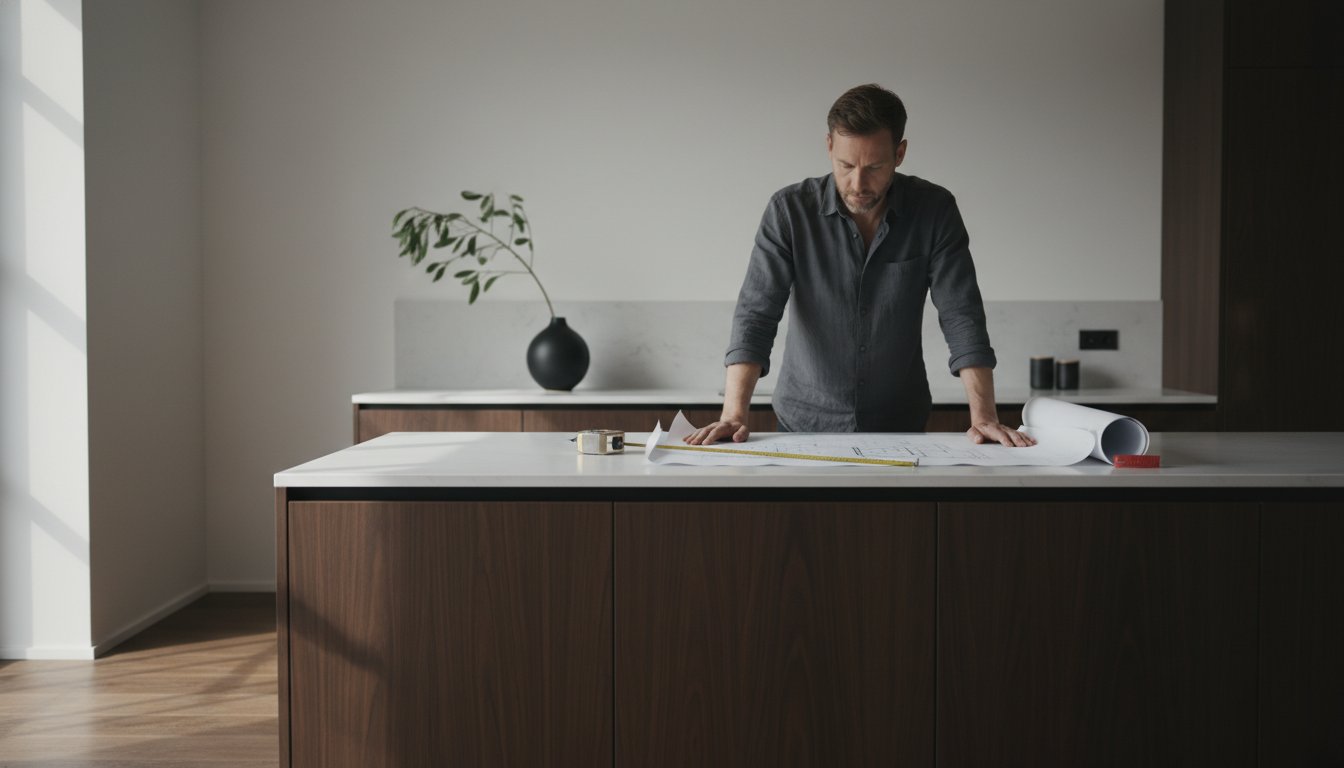
The foundation of a successful project is thorough preparatory work. Before we begin manufacturing, a detailed check of the room's conditions is required. It is rarely the case that a wall is perfectly plumb or a corner exactly 90 degrees, especially in Swedish homes built before the 1950s where deviations of several centimeters are not uncommon. By documenting these irregularities in your measurement list, we can compensate for them already in the workshop. Once you have your basic measurements, it's time to transform the vision into a drawing.
Understanding the interplay between volume and ergonomics requires experience. By booking a consultation, you gain access to our expertise on how to best optimize your kitchen measurements to create a room that is as beautiful as it is functional. Book an appointment to design your dream kitchen and let us together create a place where craftsmanship and quality of life meet.
Realize Your Kitchen Dream with Precision and Craftsmanship
Mastering the right kitchen measurements is the foundation for a home that functions in everyday life. By combining exact volume measurements with ergonomically planned work surfaces, you create an environment where the flow of movement feels natural and cooking becomes a pure pleasure. When standard fixed measurements are not enough to optimize your unique space or reflect your personal style, custom solutions open the door to a whole new level of functional luxury.
We at Indoor Wood are specialists in solid walnut and oak, where we create custom-made kitchens directly from the joinery without expensive intermediaries. Our expertise in woodworking ensures that every cabinet carcass and door is assembled with millimeter precision for a seamless finish. In our showrooms in Stockholm and Gothenburg, you get the opportunity to feel the genuine quality of the materials and be inspired by craftsmanship that is built to age with dignity for generations.
Take the step towards a kitchen environment that is completely unique to you and your home. Design your custom wooden kitchen at Indoor Wood and let us together create a place where every detail is exactly where it should be. Your dream kitchen is waiting to take shape through solid craftsmanship and timeless Scandinavian design.
Frequently Asked Questions About Kitchen Measurements
How many milliliters are in a tablespoon?
A tablespoon is exactly 15 milliliters in the Swedish measurement system. It is a fundamental unit for precision in cooking, just as millimeter measurements are crucial when assembling a solid wood kitchen. To ensure a perfect result, you should use a standardized measuring set rather than a regular table spoon, as the latter often vary in volume. Correct measurements in the kitchen create balance between ingredients and elevate the taste experience to a whole new level.
What is the standard height of a kitchen countertop?
The standard height for a countertop in a Swedish kitchen is 90 centimeters from the floor to the top of the counter. This height is optimized to suit an average-height adult and promotes an ergonomic working posture during long cooking sessions. Modern kitchens are often adjusted between 87 and 92 centimeters to meet individual needs and body heights. By choosing the right height, you protect your back and shoulders, making time at your workbench a pure pleasure.
How do I correctly measure my kitchen cabinet doors before replacement?
You measure your kitchen cabinet doors by measuring the back of the door in millimeters, from edge to edge, both in height and width. Always state the measurements as width times height to avoid misunderstandings with your joinery supplier. Also check the distance from the door's edge to the center of the hinge holes, which is usually 64 or 96 millimeters in modern systems. Precision in these kitchen measurements is crucial for your new solid wood doors to fit perfectly and provide the timeless impression you desire.
What is a work triangle and why are its measurements important?
A work triangle is the imaginary line between the kitchen's most important stations: the stove, the sink, the refrigerator, and the primary work surface. The sum of these sides should be between 4 and 7 meters to create an efficient flow without unnecessary steps during cooking. By optimizing these distances, you create a harmonious environment where craftsmanship can take center stage. Proper planning transforms the kitchen from a practical necessity into the home's natural and most functional gathering place.
How much does 1 dl of wheat flour weigh?
One deciliter of wheat flour weighs approximately 60 to 65 grams when measured correctly. To get an exact measurement, you should pour the flour into the measure rather than packing it, as tightly packed flour can weigh up to 80 grams per deciliter. Precision in weight is as important for successful dough as accuracy in kitchen measurements is for durable interior design. Feel free to use a digital kitchen scale to ensure that your recipes always deliver the same high quality and consistency.
What depth should a kitchen island have?
A kitchen island should have a depth of at least 60 centimeters, but for optimal function and aesthetics, 90 to 120 centimeters is recommended. If the island is to accommodate both storage and seating, a greater depth is required to create a generous overhang for legs. This gives a sense of luxury and stability reminiscent of the solid wood floors we at IndoorWood highly value. The right depth makes the island a natural gathering point for both everyday tasks and festive occasions in the home.
What is the difference between measurements in recipes and measurements in drawings?
The difference lies primarily in the units, where recipes focus on volume such as deciliters and tablespoons, while drawings use millimeters for exact fit. In a drawing, precision is absolute for the craftsmanship to work, while recipes allow a certain artistic freedom and taste variation. However, both types of kitchen measurements require an understanding of the material's properties and the unique conditions of the space. Mastering both worlds is key to a home that is both practical and aesthetically inspiring.
How wide should the distance between two opposing counter rows be?
The distance between two opposing counter rows should be at least 120 centimeters to allow two people to work simultaneously without colliding. This measurement ensures that drawers and dishwasher doors can be fully opened without annoyingly blocking passage through the room. In smaller spaces, 100 centimeters can be accepted as an absolute minimum, but it noticeably limits freedom of movement. A well-measured distance creates an airy atmosphere that allows the kitchen's materials and craftsmanship to truly shine.