Wooden Kitchen in Your Own Stain: Create a Unique Character with Custom Shades
What happens to a room's soul when you dare to choose something completely unique instead of standard colours? Many hesitate to change the natural tone of wood, as the fear of concealing the beautiful grain often outweighs the desire for renewal. We understand that concern. A solid wood kitchen is an investment in both craftsmanship and quality of life, and the material's natural vibrancy should never have to be sacrificed for a specific colour. By choosing a custom-stained wood kitchen, you can instead enhance the wood's character and create an atmosphere that feels both personal and timeless.
In this guide, you will learn how to combine the natural beauty of solid wood with a completely unique colour tone to create your dream kitchen. We show how modern surface treatment technology makes it possible to achieve a durable and easy-to-maintain surface that withstands everyday challenges, while preserving the tactile texture completely intact. We review how to visualize the final result and ensure that your project is treated with the care and precision required to transform your vision into reality.
Key Takeaways
- Learn how transparent stain highlights the unique grain of wood, creating an aesthetic depth that opaque paint can never replicate.
- Understand how the choice of wood, such as oak, ash, or walnut, serves as the crucial base for how the pigment is absorbed and presented.
- Discover the method for ensuring that your custom-stained wood kitchen achieves the exact right shade in your home's specific lighting conditions through physical samples.
- Get practical advice on how the right surface treatment with hardwax oil or lacquer protects your kitchen against moisture and heat without compromising the feel.
- Explore how custom-made solutions enable a seamless combination of personal design vision and Indoor Wood's genuine craftsmanship.
What does a custom-stained wood kitchen mean?
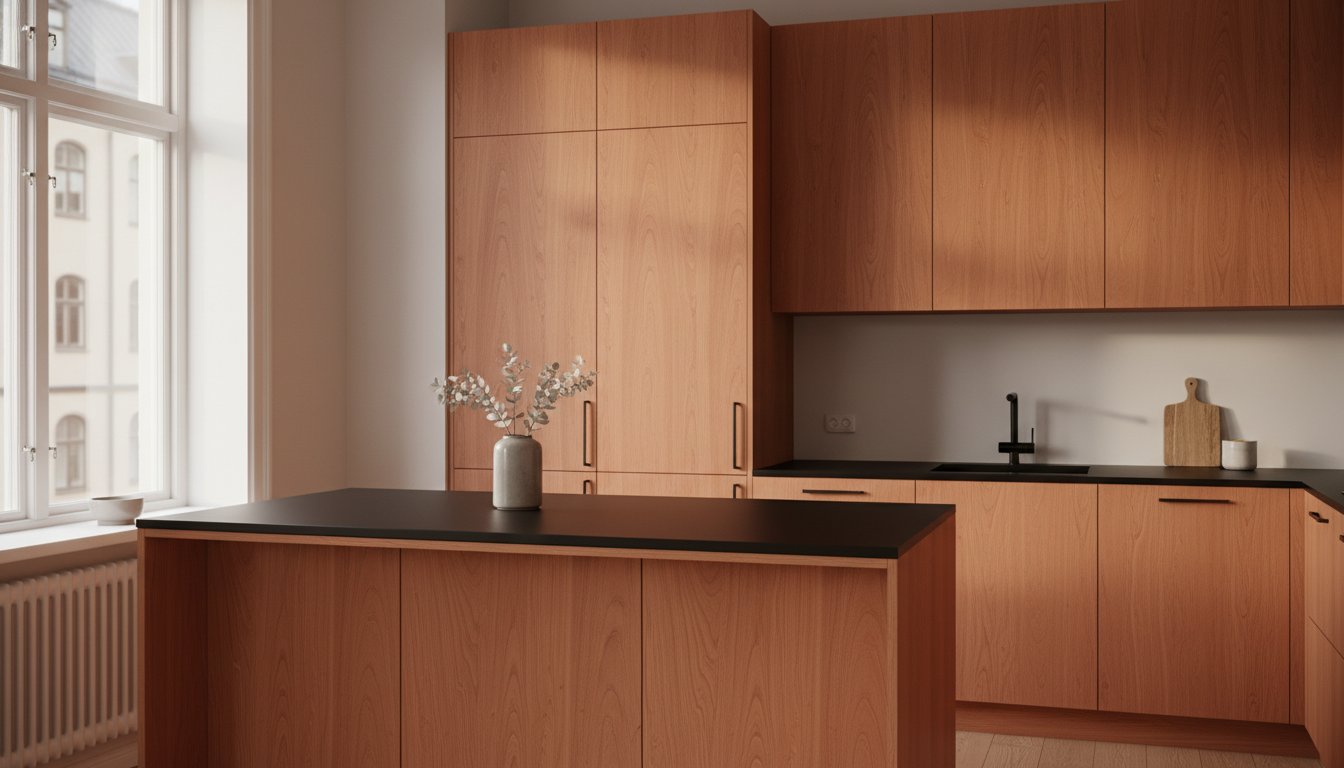
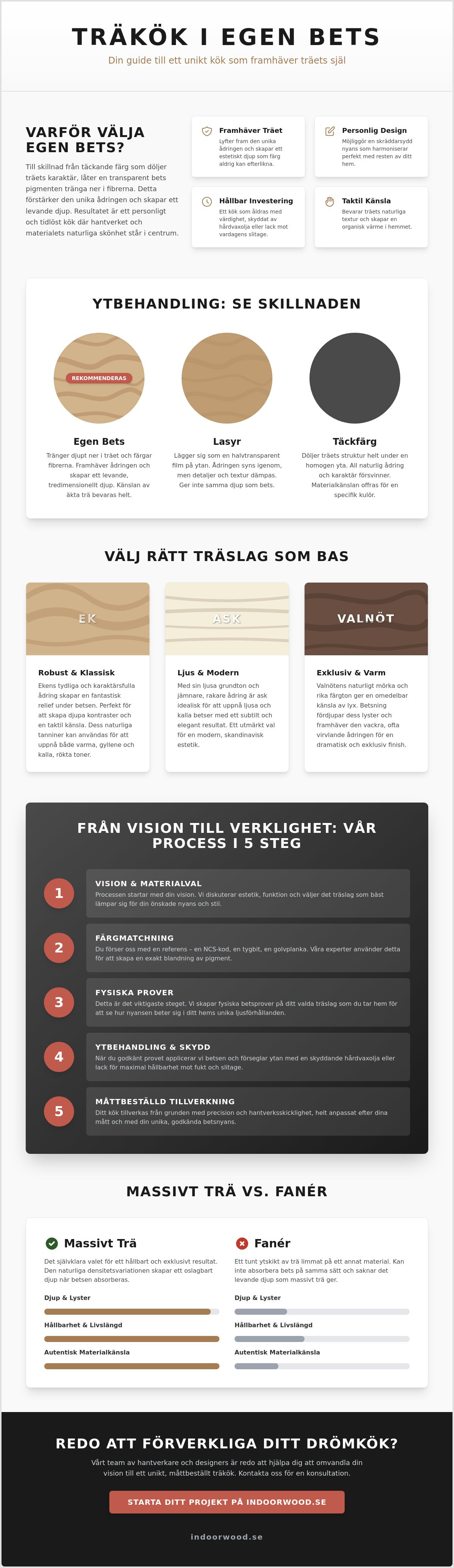
A custom-stained wood kitchen is about more than just colour choice; it's a tribute to the material's natural variations and inherent soul. By using a transparent surface treatment, the pigments penetrate the wood fibres without obscuring the unique grain. This is where craftsmanship truly shines. Unlike opaque painted surfaces, which create a homogeneous film over the wood, stain allows every knot and line to tell its story. To understand the entirety of this process, one can study The Basics of Wood Finishing, which provides a deeper insight into how different techniques affect the material's durability and appearance.
The difference between various surface treatments is significant in a kitchen environment. Opaque paint completely conceals the wood's structure, while glaze often sits as a semi-transparent film on the surface. Stain, however, is absorbed by the wood and provides a depth effect that is impossible to achieve with ordinary lacquering. Choosing a tailored shade means that the kitchen becomes not just a functional part of the home, but a unique piece of furniture craftsmanship. Aesthetically, it creates an exclusivity that feels both timeless and personal. It is a conscious choice for those who value long-term quality over fleeting trends.
Economically, a unique staining is a wise investment. Although the process requires more precision and craftsmanship than standard solutions, it increases the total value of the home by creating a cohesive and exclusive interior. A well-executed custom-stained wood kitchen ages with dignity and can often be refreshed without needing to replace the entire cabinetry, saving significant amounts over time compared to cheaper laminate solutions.
The role of stain in modern interior design
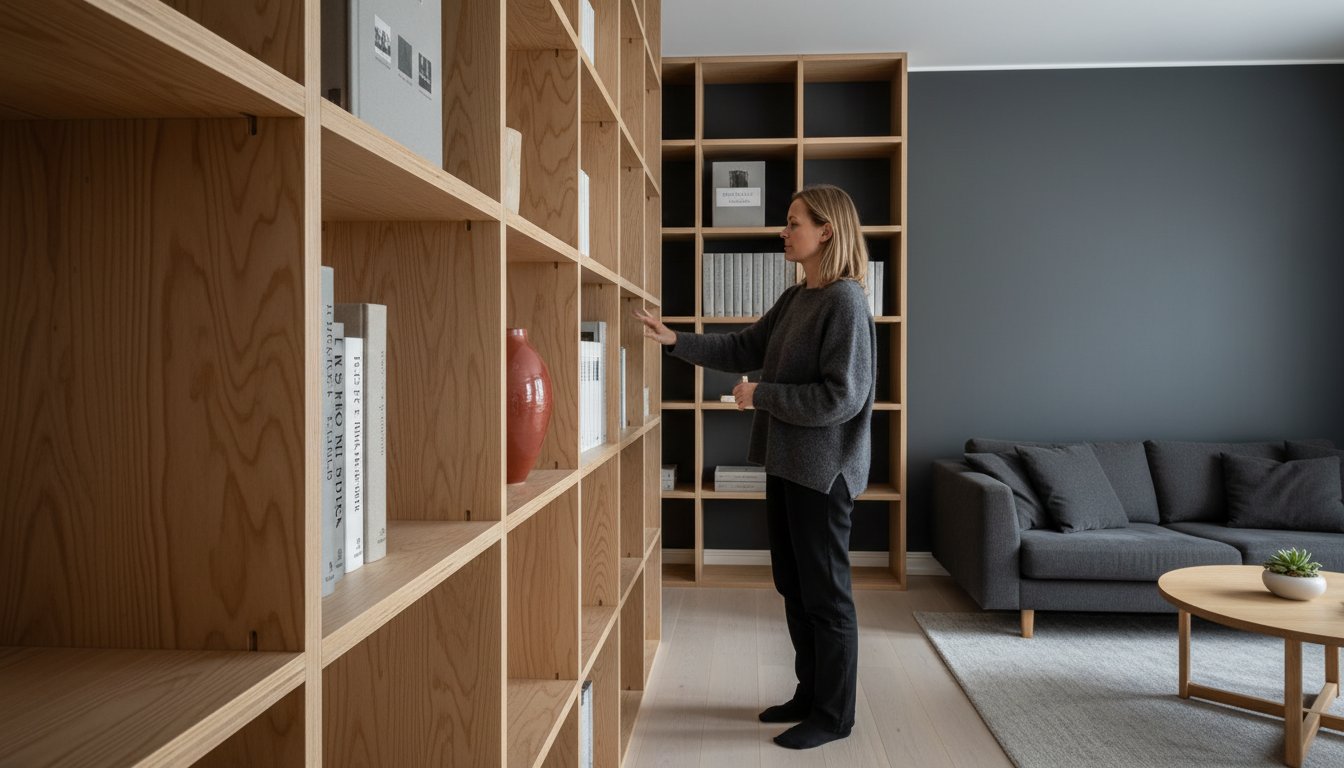
In today's Scandinavian homes, where minimalism often dominates, stained wood plays a crucial role. It adds an organic warmth that balances hard materials such as stone, concrete, and metal. A major advantage of custom staining is the ability to harmonize the kitchen's tone with existing elements in the home, such as a solid oak floor or custom-built bookshelves. This tactile sense of authentic materials creates a calm and inviting atmosphere that permeates the entire room.
Solid wood vs. veneer for staining
The choice of raw material is absolutely crucial for how the end result is perceived. Solid wood has a natural density variation that causes the stain to be absorbed differently in different parts of the plank. This creates a lively depth where light refracts in a way that veneer rarely can replicate. Indoor Wood consistently works with materials of the highest grade to ensure that every surface interacts optimally with the pigments. Quality at the foundation is the prerequisite for the chosen shade to reach its full potential and maintain its luster for decades.
Choose the right wood for your stain: Oak, ash, or walnut?
The foundation for a successful custom-stained wood kitchen lies not in the colour choice itself, but in understanding the living material beneath the surface. Each wood species possesses a unique chemical composition and cellular structure that dictates how pigments are received. The wood's natural base tone acts as a filter; a grey stain on yellowish pine will never look the same as on whitish ash. The pore structure is the decisive factor for how much pigment the wood absorbs. Large, open pores eagerly soak up the liquid, creating depth, while denser woods give a more subtle and even result.
Achieving a professional end result requires an aesthetic sensibility for the material's variations. A single plank can have a density that differs by 10–15% from its neighbour, which affects how dark the stain appears. Understanding these technical fundamentals is crucial, and for those who wish to delve deeper into the fundamental principles of surface treatment, there are educational Care Tips for Stained Surfaces that illustrate how different finishes interact with wood fibres.
Oak kitchens: The robust classic for staining
Oak is undoubtedly the most rewarding wood species when working with custom shades. Its characteristic and clear grain creates a natural relief under the stain. When the pigment settles in the deep pores, the wood's texture is enhanced, giving the kitchen a tactile and exclusive feel. An important aspect to manage is oak's natural tannins. These tannic acids can react with certain stains and either highlight warm golden tones or help create the coveted cool, smoked shades that are so popular in modern Scandinavian design.
To succeed with a harmonious oak kitchen, consider the following:
- Selection: Choose the grade with care; a rustic oak with many knots gives a completely different expression than a selected, knot-free surface.
- Contrast: Dark stains on oak emphasize the grain pattern maximally.
- Balance: Use pigments that complement oak's inherent strength rather than concealing it.
Ash and walnut: From light to dramatic
Ash serves as a white canvas for those seeking a lighter custom-stained wood kitchen. Thanks to its naturally pale tone, ash is ideal for white-pigmented or pastel-coloured stains where you want to maintain freshness without the wood "shining through" with yellow tones. Ash is also a very hard and durable wood, often with higher impact resistance than oak, making it an excellent choice for kitchen environments exposed to daily wear and tear.
Walnut, on the other hand, possesses a natural darkness and an exclusive luster. Here, staining often involves evening out colour differences between heartwood and sapwood rather than changing the colour entirely. A light pigmentation can give walnut a deeper, more chocolate-brown tone that feels timeless. Before making the final decision, we recommend you explore our material samples to experience how the light in your specific room interacts with the wood's texture and the depth of the stain.
Step-by-step: How to choose and test your unique shade
Creating a custom-stained wood kitchen is about translating a personal vision into a physical craft that will last for decades. The process often begins with a collection of inspiration images, but digital screens can never replace the tactile experience of reality. Each wood species has its own chemistry and density, meaning a stain that looks perfect in a picture can appear completely different on your specific kitchen door. Therefore, always order samples of the exact wood species you have chosen, whether it's the robust grain of oak or the more lively pattern of ash.
Once you receive your samples, the most important work begins: evaluation. A shade that feels balanced in the cold morning light at 08:00 can be perceived drastically differently when the evening sun or kitchen lighting takes over. Let the sample travel through the room for a day. We consider it an absolute prerequisite that you view the sample vertically, just as the doors will be mounted. The refraction of light against the wood fibres changes fundamentally when the angle shifts from horizontal to vertical.
- Gather inspiration but let the physical sample guide the final decision.
- Always test the shade on the specific wood species from which the kitchen will be made.
- Observe how the pigments react in both natural daylight and artificial lighting.
- Examine the surface vertically to simulate the finished assembly.
- Give your final approval only when you feel completely confident with the overall result.
From colour code to finished surface
Communication with the joinery is key to success. An NCS code often serves as a technical starting point, but to achieve the exact saturation in a custom-stained wood kitchen, a craftsman's intuition is required. The pigments are mixed and adjusted manually to harmonize with the wood's natural colour variations. For a custom-made wood kitchen, a physical final sample is mandatory. This is your guarantee that the vision you have in mind is actually manifested in the finished result.
The effect of lighting on stained surfaces
Light is the factor that most influences how we perceive colour and texture. A warm LED lighting with a value of 2700 Kelvin can make a cool, greyish stain tend towards yellow, while a neutral light of 3000 Kelvin better preserves the purity of the shade. The gloss level of the topcoat also plays a crucial role. A completely matte surface absorbs light and gives a calm, deep impression, while a higher gloss reflects the surroundings. Create a mood board where you place your stained sample piece together with samples of the countertop and the intended wall colour to ensure a harmonious balance in the room.
Durability and care of stained wood surfaces
A custom-stained wood kitchen requires the right surface treatment to maintain its beauty through decades of cooking and social gatherings. The choice between hardwax oil and clear lacquer is often crucial for both the aesthetic experience and practical maintenance. Clear lacquer creates a hard, dense film that provides very strong protection against moisture and stains, but if the surface is scratched, it is difficult to repair without sanding down the entire door. Hardwax oil, on the other hand, penetrates the wood's pores and preserves the natural, tactile feel. It provides a living surface that breathes and is significantly easier to spot-repair if an accident occurs.
In an active kitchen environment, surfaces are exposed daily to steam, grease, and spills. A surface treated with high-quality hardwax oil handles these stresses excellently, provided that liquids are wiped up within a reasonable time. It is also important to understand how natural light affects your custom-stained wood kitchen. UV radiation gradually changes the wood's colour tone; darker stains may fade slightly while lighter wood species often darken. This process occurs slowly over 5 to 10 years and gives the kitchen a beautiful patina that testifies to a living material.
Daily cleaning and maintenance
To preserve the integrity of the surface, you should avoid strong cleaning agents that contain ammonia, alcohol, or abrasives. These chemicals dissolve the protective wax or lacquer and make the wood vulnerable to moisture. A slightly dampened cloth with a drop of mild linseed oil soap is usually all that is needed to keep the surface clean. It is critical to wipe up spills from wine, coffee, or lemon immediately to prevent pigments from penetrating the wood fibres. By regularly maintaining the surface with recommended care products, you preserve the luster of a solid wood so that it ages with dignity year after year.
Renovation and future adaptations
The greatest advantage of choosing genuine wood material is its exceptional lifespan. If you wish to renew the kitchen's appearance after 15 years, you don't need to replace the entire interior. Instead, the surface can be sanded down and re-stained in a completely new shade. This is a sustainable and circular way of viewing your investment that saves both environmental resources and money compared to installing a brand new kitchen. For minor mishaps, such as deep scratches or impact damage, one can often sand locally on the damaged area and apply new stain and oil with precision to make the repair virtually invisible.
Want to know more about how to choose the right material for your next project? Explore our range of sustainable wood materials here
Realize your vision with Indoor Wood's custom-made solutions
Creating a home that feels genuine and personal requires more than just standard choices. It requires an eye for detail and a deep understanding of the material's inherent power. At Indoor Wood, we have dedicated our business to bridging the gap between large-scale production and unique craftsmanship. By offering a custom-stained wood kitchen, we give you the opportunity to dictate the room's atmosphere down to the smallest shade. Our expertise lies in transforming raw wood species into finished kitchen fronts that fit perfectly on everything from brand new carcasses to existing solutions in older properties.
We have chosen to work without intermediaries. Through direct dialogue with our manufacturers, we ensure that every component maintains the high quality required to withstand everyday wear and tear for decades. This close contact allows us to maintain a competitive price without compromising the precision of the craftsmanship. Flexibility is our greatest strength. We can combine standard dimensions with completely unique solutions, which means we can maximize the potential of every square meter, whether it's a compact city kitchen or a spacious dream villa.
To truly understand the difference between various treatments, we always recommend a visit to our showrooms. There you can see how light falls over a surface of oak, ash, or walnut and experience how a custom-stained wood kitchen changes character depending on pigmentation and gloss value. It's a tactile experience that digital images can never fully replace.
Why choose Indoor Wood for your unique kitchen?
As a family business, we are driven by a personal passion for wood as a natural material. We look not only at the technical implementation of the project but also at the emotional experience of living in a beautiful home. Our solution is compatible with both IKEA's Metod and Faktum systems, making it possible to upgrade an existing kitchen to an exclusive level with sustainable materials as a foundation. We work exclusively with certified wood species such as oak, ash, and walnut to guarantee a product that ages with dignity.
Next steps towards your dream kitchen
The path to a custom-made kitchen is a safe and inspiring process with us. We guide you from the first sketch to the final delivery to your door. To start your journey, you can:
- Book a personal consultation with our experts to discuss your visions.
- Order product samples to see how different stains interact with the light in your home.
- Visit our exhibition environments to experience the craftsmanship up close.
Investing in a kitchen from Indoor Wood is investing in your own quality of life and the long-term market value of your home. We look forward to helping you create a space where nature and design meet in perfect harmony.
Realize your vision with timeless craftsmanship
Choosing a custom-stained wood kitchen is to give your home a unique identity that lasts for generations. By combining the right wood species such as oak or ash with a custom shade, you create an atmosphere that neither standard solutions nor mass production can replicate. The key to a successful result lies in the precision of sample painting and the understanding of how the wood's natural grain interacts with the pigments. It's about finding the exact balance where the material's soul is allowed to take its place and enhance the room's character.
As a Swedish family business focusing on fine wood, Indoor Wood works completely without intermediaries. This means we can offer high-quality production and custom-made solutions for all types of carcasses, regardless of the project's scope. Our craftsmanship combines technical expertise with a deep respect for the raw material, giving you a kitchen that is as durable as it is beautiful. Every detail is sanded and treated with a care that only a passionate master can deliver. Let nature's own variations become the foundation of your interior design and create a place where every surface feels genuine and welcoming.
Design your unique wood kitchen – Contact Indoor Wood today
Frequently asked questions about custom-stained wood kitchens
Can all types of wood be stained for the kitchen?
Yes, most solid wood species can be stained, but the result varies depending on the wood's fibre structure and density. Oak and ash are particularly rewarding materials as their open pores absorb the pigment evenly and beautifully highlight the grain. Maple and cherry have denser fibres that require a more technical application to avoid patchiness in the final result.
How much more expensive is a custom-stained wood kitchen compared to standard?
A bespoke stained wooden kitchen represents a higher investment than standard options, as the process includes manual sample painting and color matching in a laboratory environment. The additional cost reflects the extra labor required to precisely calibrate the shade to your specifications. The price is entirely determined by the number of doors and the complexity of the chosen color, making each project unique in its calculation.
Is it possible to match the stain to my existing wooden floor?
Yes, we can create an almost identical match between your kitchen and your existing wooden floor by analyzing the floor's pigment and wood type. By producing customized samples, we ensure that the kitchen's vertical surfaces harmonize with the floor's horizontal plane. This creates a seamless visual transition that naturally anchors your bespoke stained wooden kitchen into the room's architecture.
What protective layer is best on a stained kitchen door?
A high-quality hard wax oil or a matte furniture lacquer provides the most durable protection for kitchen surfaces. Hard wax oil penetrates deep into the wood, preserving its natural feel while providing strong protection against spills and stains. For surfaces exposed to extreme wear in families with children, a two-component lacquer can be an alternative to maximize resistance to moisture.
What does maintenance look like for a stained wooden kitchen over time?
Maintenance is simple and primarily requires regular wiping with a damp cloth and a mild, pH-neutral cleaning agent. If the kitchen is treated with hard wax oil, the surfaces should be maintained with a nourishing oil every two or three years to retain their luster. Avoid strong chemicals that can dissolve the protective layer or fade the pigments in your bespoke stained wooden kitchen.
Can I use Indoor Wood's stained doors on my old IKEA frames?
Yes, our custom-made doors are technically compatible with both new and older IKEA frames, such as Metod and Faktum. We drill holes for hinges and drawer fronts with millimeter precision based on the dimension drawings that have been in use since the 1990s. This makes it possible to upgrade a functional kitchen to an exclusive design without having to tear out the entire frame.
What is the delivery time for a custom-made stained kitchen?
The delivery time for a custom-made kitchen is typically between 6 and 10 weeks from the time the color sample is approved by you. This period includes artisanal manufacturing, drying times for the surface treatment, and a thorough eight-step quality control. We communicate an exact delivery week as soon as your order is placed in production to facilitate your planning with craftsmen.
What happens if I accidentally scratch a stained wooden door?
One of the great advantages of wood is that minor scratches can often be repaired locally without the need to replace the entire door. By carefully sanding the surface and applying a small amount of the original stain, the appearance is effectively restored. For deeper damage, a wood wax in a matching color can be used to fill the unevenness before the surface is sealed again with protective lacquer or oil.