Plywood Sheets: A complete guide to material selection, quality, and design 2026
Confusing an exclusive plywood sheet with a simple particle board is a mistake that can cost both the aesthetics and longevity of your next home project. It's easy to feel lost among technical terms and worry about the material warping or delaminating when the humidity in the room shifts. We share your passion for wood's natural character and understand that you seek that unique balance where nature's raw beauty meets modern engineering, without compromising craftsmanship's precision.
In this comprehensive guide for 2026, you will learn everything about how to choose the right board for both hidden constructions and custom-built interiors with an exclusive finish. You will get the practical tools to decipher quality markings like B/BB and understand why specific wood species perform better than others in our challenging Scandinavian climate. We show you how to transform a functional plywood sheet into a timeless design element with the right surface treatment and a delicate touch, elevating the entire room's atmosphere and serving as a foundation for your home.
Key Takeaways
- Understand why cross-laminated veneer layers make a plywood sheet more dimensionally stable and durable than solid wood for larger interior projects.
- Learn to identify the right wood species for your purpose, from pine's natural character to birch's elegant and durable surface.
- Gain full control over quality classes and how to choose the right face veneer to achieve a perfect finish for clear coating or painting.
- Discover why plywood is the superior choice over MDF when you seek a combination of genuine wood feel and long-term strength.
- Get expert tips on surface treatments that highlight the wood's unique luster and create a timeless, Scandinavian atmosphere in your home.
What is a plywood sheet? The foundation for dimensionally stable design
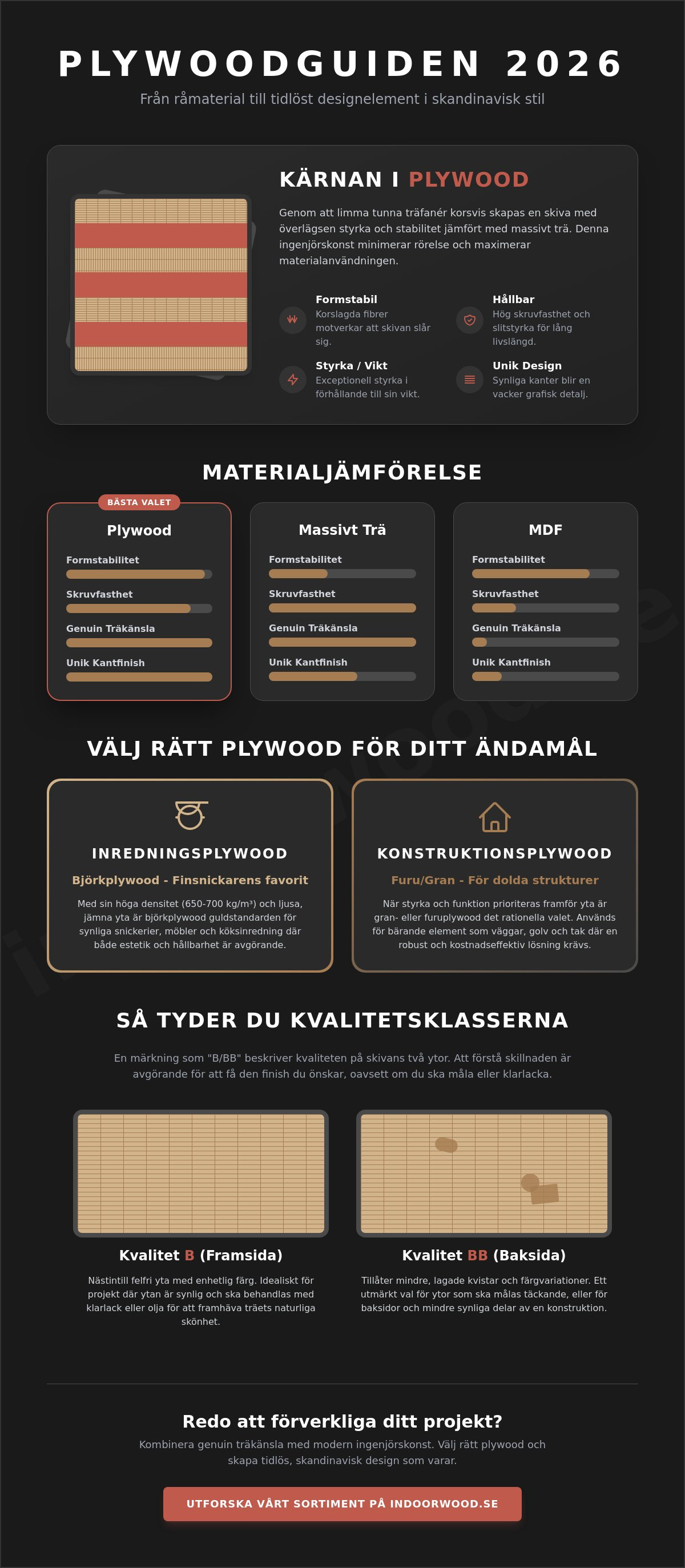
A What is a plywood sheet? in its purest form is the result of human engineering meeting nature's raw strength. It involves thin layers of wood veneer glued together under extreme pressure. By laying the fibers perpendicular to each other, a stability is created that solid wood rarely matches in large formats. Already in antiquity, craftsmen used similar techniques to create durable furniture, but it is in modern Scandinavian minimalism that the material has truly found its home as an exclusive choice.
Choosing a plywood sheet is also a conscious choice for the environment. The manufacturing process maximizes the raw material so that almost the entire log is utilized. This significantly reduces waste compared to traditional plank sawing, where losses are often substantial. This is a timeless investment that unites craft tradition with 2026's demands for resource efficiency and aesthetic sustainability.
Construction and manufacturing technique
Cross-lamination is the technical secret behind the board's unique properties. By having each layer counteract the next, a mechanical balance is created that prevents the wood from warping or cracking when the humidity in our Swedish homes shifts between seasons. We always ensure to use boards with an odd number of layers. This is a prerequisite for the board to remain completely flat and symmetrical over time. The choice of adhesive then defines where the board can be used. Interior adhesive is excellent for custom-built wardrobes and design furniture. For projects in more humid environments or where durability requirements are extreme, water-resistant adhesive, often designated as WBP (Water and Boil Proof), is used.
Why choose plywood over other sheet materials?
Strength-to-weight ratio is plywood's main trump card. Compared to a standard particle board, it offers superior screw holding capacity and mechanical stability. This means your constructions will withstand both heavy loads and daily use for decades. It is a material that exudes quality and precision. Many of today's most prominent interior designers choose to leave the characteristic edges completely visible. The striped layers become a beautiful, graphic detail that exposes the core of the craftsmanship. It is an honesty in the material that creates a genuine and luxurious atmosphere in every room it is placed in.
- Sustainability: Maximized utilization of the forest.
- Dimensional stability: Cross-laid fibers minimize movement.
- Design: Visible edges provide a unique character.
Different types of plywood: From birch to pine
The choice of wood species in a plywood sheet determines not only the aesthetics of the final result but also its technical lifespan and stability. Each wood species possesses unique properties that respond to different requirements for strength and visual character. In 2026, we see a clear trend where the material's natural variations are given greater prominence in Scandinavian interior architecture, from the light, almost transparent birch surfaces to the deep, dark tones of walnut.
Birch plywood – The fine carpenter's favorite
Birch plywood is often considered the gold standard for visible joinery. Its high density, typically between 650 and 700 kg/m³, gives the board exceptional strength and screw retention. What truly distinguishes birch is its homogeneous structure; the thin veneer layers, often with a precise thickness of 1.4 mm, create the characteristic and sharp edges that have become a hallmark of modern furniture design. For public environments and kitchens, birch's hardness is a crucial advantage as it resists impacts and marks significantly better than softer wood species.
Structural plywood vs. Interior plywood
When the focus is on hidden structures or load-bearing elements, spruce or pine plywood is the most rational choice. A spruce plywood with the classification K20/70 is optimized for strength rather than surface finish and is widely used in wall constructions and floor joists. Plywood vs. MDF and solid wood is a relevant comparison here; plywood's cross-laminated structure means it moves minimally with humidity variations compared to solid wood, while retaining a natural grain direction that MDF lacks.
- Exterior plywood: Glued with waterproof phenolic adhesive (WBP) to withstand humid environments and outdoor use.
- Formwork plywood: A specially treated plywood sheet with a dark phenolic film on the surface, originally developed for concrete casting but now popular in industrial interior design.
- Noble face veneers: For exclusive projects, a birch core can be clad with face veneers of oak, ash, or walnut to combine plywood's stability with the luxurious feel of hardwood.
Understanding the difference between these materials is key to a successful project. A simpler structural board serves its purpose behind drywall, but for custom-built bookshelves or kitchen fronts, the precision of high-quality interior plywood is required. For those seeking the perfect balance between aesthetics and durability, you can explore how we work with natural wood materials to create timeless environments.
Whether you choose the rustic charm of pine or the elegant stringency of birch, each board is a living material. Precision in manufacturing ensures that your investment lasts for generations, making the choice of material one of the most important decisions in the building process.
Quality classes and thicknesses: How to read the specifications
Choosing the right plywood sheet is about understanding the balance between aesthetics and structural integrity. The industry uses a letter system to grade the face veneer, which directly affects both price and the final result. A sheet is usually graded with two letters, for example, B/BB, where the first letter indicates the quality of the front and the second of the back. A-grade is the most exclusive surface, almost free from knots and color variations, perfect for projects where the wood should speak for itself. B-grade allows for small, healthy knots and minimal color variations, giving it a natural character. As we move towards BB, CP, and C, the number of repairs and knots increases. According to Plywood basics from the Engineered Wood Association, it is precisely these outer layers that define the area of use, while the inner layers ensure the mechanical strength of the board.Guide to surface finish and sorting
Class B/BB is the golden mean for interior joinery. Here you get a front that is beautiful enough for clear lacquer or stain, while the back may have visible repairs. The term "repaired knots" means that natural defects have been punched out and replaced with fresh veneer pieces, often shaped like small ovals or "fish." For projects requiring an absolutely homogeneous surface, for example for advanced laser cutting, S-grade is the optimal choice as it offers an almost perfect surface with minimal texture variation.Choosing the right thickness for the project
Precision in material selection saves both time and money. The choice of thickness is entirely governed by the load your plywood sheet will be subjected to:- 4–6 mm: Ideal for cabinet backs, drawer bottoms, or when you need to create curved shapes and organic lines.
- 12–18 mm: The standard choice for cabinet carcasses, robust shelves, and lighter furniture constructions. 15 mm is often a favorite for kitchen interiors.
- 21–30+ mm: Used for load-bearing constructions, substantial tabletops, or stair treads where stability and minimal deflection are crucial.
Plywood vs. MDF and solid wood: A material comparison
Choosing the right sheet material is about understanding the balance between budget, load-bearing capacity, and the visual identity you want to create in your home. A plywood sheet offers a unique combination of natural beauty and technical superiority that often places it squarely between the economical choice of MDF and the exclusive solid wood. The choice determines not only how the furniture looks today, but how it will perform in ten or twenty years.
Plywood or MDF?
MDF (Medium Density Fibreboard) is often the obvious choice for those seeking a completely smooth, opaque painted surface without visible structure. It is a homogeneous material that is easy to mill, but it lacks the inherent strength of plywood. A plywood sheet almost always wins when long-term durability is the focus. Thanks to the cross-laminated veneer layers, plywood withstands heavy loads without yielding, making it ideal for custom-built bookshelves and load-bearing constructions. If you are planning a project where the surface is to be fully painted, you can read more about the advantages of an MDF sheet in our guide. However, for furniture that needs to withstand daily wear and tear for decades, plywood's dimensional stability and moisture resistance are superior.
Invest in quality: From plywood to hardwood
Sometimes a room requires a presence that only solid wood can deliver. It's about the weight, the scent, and the tactile feel of a material that is genuine throughout. At Indoor Wood, we don't see plywood and hardwood as competitors, but as natural complements in modern interior design. By combining the materials, both technical perfection and aesthetic luxury can be achieved.
- Price and value: MDF is the most budget-friendly, plywood is in the mid-range, while solid wood is a significant investment that increases the value of the home.
- Strength: Plywood has the highest load-bearing capacity in relation to its weight, saving space in the construction.
- Aesthetic expression: Solid wood provides the most character, while plywood offers an honest, Scandinavian wood feel with its visible edges.
A popular way to create a common thread in the home is to use plywood for frames and hidden details, and then crown the design with hardwood fronts. Matching subtle plywood details in the kitchen with an exclusive walnut bathroom vanity creates visual harmony. It unites the functional with the artisanal. We focus on materials that age with dignity, where every mark in the wood becomes part of the home's history.
Want to know more about how to choose the right material for your vision? Explore our range and find the right material for your next renovation.
Designing and working with plywood: Tips for a professional result
Working with a plywood sheet requires both technical precision and a deep understanding of the wood's inherent character. To achieve that exclusive result that exudes craftsmanship, it's all about preparation and the right tool choices. It's about transforming a raw material into a permanent part of the home's architecture. To prevent the delicate face veneer from splintering during cutting, you should use a plunge saw with a fine-toothed blade. A blade with 48 to 60 teeth on a 160 mm diameter significantly minimizes the risk of chipping. A proven craftsman's trick is to apply high-quality masking tape along the cutting line before sawing. This holds the wood fibers in place and provides a razor-sharp edge that requires minimal post-processing. The choice of surface treatment is crucial for how the material interacts with the room's light. A matte hard wax oil preserves the tactile feel and enhances the wood's natural luster without creating a plastic-like surface. In a bedroom, a white-pigmented oil can prevent birch plywood from yellowing over time, preserving the fresh, Scandinavian aesthetic. The exposed edges have become a modern signature in contemporary design; by sanding them silky smooth and sealing them with wax, you create an honest and architectural look that celebrates the material's construction.Carpentry tips for plywood projects
Precision is your best friend when handling thin face veneers. When sanding, use light pressure and go from grit size 120 to 240. Since the top layer of a plywood sheet is often thinner than 1.5 mm, overly aggressive sanding risks exposing the adhesive layer underneath, which ruins the surface. For joining, biscuit jointing or hidden screw joints are recommended. This provides structural integrity that withstands the load in a custom-built kitchen while the exterior remains completely clean and free from distracting fittings.Create a timeless interior with an Indoor Wood feel
Harmony in the home arises when fixed furnishings meet well-thought-out details. By combining your plywood projects with exclusive wooden boxesRealize your vision with artisanal precision
Choosing the right plywood sheet is about more than just the surface. It's a strategic decision that affects both the construction's durability and the room's long-term character. By combining knowledge of wood species like birch and pine with a deeper understanding of international quality classes, you create the conditions for a result that exudes professionalism. The material's dimensional stability makes it a superior partner for both complex furniture projects and elegant interior details that will last long after 2026.
At Indoor Wood, we see ourselves as your advisory partner throughout the design journey. We specialize in hardwoods such as walnut and oak, where every fiber tells a story of sustainability and timeless aesthetics. In our showrooms in Stockholm and Gothenburg, you can experience for yourself the difference that genuine craftsmanship makes to the atmosphere of a home. We are happy to guide you to the material choices that best highlight your unique style and create that genuine feeling of luxury in everyday life.
Explore our range of solid wood and plywood interiors at Indoor Wood
Take the step towards a more harmonious home where every detail is chosen with care and respect for nature's own works of art.
Common questions about plywood
What is the difference between plywood and cross-laminated veneer?
There is no technical difference between the materials as plywood and cross-laminated veneer are two names for the exact same construction. Cross-laminated veneer is the older, more descriptive Swedish term that explains how thin layers of wood, called veneers, are glued crosswise to create stability. In today's building trade, plywood sheet is the dominant term, but both names refer to the robust board that has become a cornerstone of Scandinavian design.
What thickness of plywood sheet should I use for a shelf?
For a stable bookshelf with a span of 60 to 80 centimeters, you should choose a thickness of at least 18 millimeters. If the construction is to bear heavier objects or has longer distances between support points, 21 or 24 millimeters is a safer choice to avoid sagging. A thinner plywood sheet of 12 millimeters works well for smaller decorative shelves, but lacks the load-bearing capacity required for functional storage furniture.
Can plywood be used outdoors?
Plywood can be used outdoors if it is glued with a waterproof adhesive, often marked with the designation WBP or Exterior. Pine or larch plywood boards are particularly suitable for Nordic conditions due to their natural resistance to moisture. However, it is crucial to seal all edges carefully with a penetrating oil or paint, as the end grain otherwise absorbs water and causes delamination over time.
How do I prevent the plywood sheet from warping?
You prevent the material from warping by allowing the sheet to acclimatize at room temperature for 48 hours before starting processing. Wood is a living material that breathes, and tensions often arise if only one side is surface-treated. By painting or oiling both sides of your plywood sheet with the same method, you balance the surface's moisture absorption. This simple step is the secret behind craftsmanship that remains straight and elegant throughout the years.
Which quality class is needed for building furniture?
For visible furniture surfaces, quality class A or B is recommended, where the surface is virtually free of knots and repairs. Class B/BB is a common combination where the front has a high visual standard while the back allows for minor corrections. Lower classes such as C or WG are primarily used for constructions that will be hidden or covered. Choosing a higher grade from the start saves valuable time during sanding and provides that exclusive feel that characterizes true quality.
Is plywood environmentally friendly?
Plywood is an environmentally smart choice because its manufacturing method utilizes wood raw material extremely efficiently by peeling the log into thin layers. To guarantee a sustainable origin, one should choose boards certified with FSC or PEFC, which confirms that the wood comes from responsible forestry. According to reports from 2023, wood-based panel materials have a significantly lower carbon footprint than conventional building materials such as steel and concrete, while also acting as a natural carbon sink in the home.
What is the best way to paint a plywood sheet?
The best result is achieved by first sanding the surface with 180-grit sandpaper and then applying a primer that saturates the wood fibers. After the primer has dried, you should lightly sand the surface again to remove raised fibers before applying two coats of topcoat with a felt roller. This method highlights the natural texture of a plywood sheet while creating a durable surface. It provides a sophisticated finish that can withstand the rigors of everyday life in an active home environment.
How much does a birch plywood sheet cost compared to pine?
A birch sheet generally costs between 40 and 60 percent more than a corresponding pine sheet on the Swedish market. This price difference is due to birch's higher density, its light and even aesthetic, and the fact that it is often composed of more and thinner layers. Pine is an excellent and more economical alternative for projects where a clear wood grain is desired. The choice often comes down to the rustic warmth of pine and the timeless, minimalist elegance of birch.