Wood as a Sustainable Material in Bathrooms: A Guide to Timeless Renovation
Can a material that lives and breathes actually be the most reliable choice for the most exposed room in the home? Many shy away from the idea of wood in wet areas for fear of moisture and mold; a concern that often leads to choosing mass-produced chipboard furniture that swells at the slightest contact with steam. But the truth is that wood as a sustainable material in bathrooms is not just an aesthetic dream. It is an investment in solid quality that, unlike plastic film and glued boards, can actually be maintained and preserved for decades.
We share your passion for the natural and at the same time understand the technical challenges that the new industry regulations Safe Wet Rooms 2026 entail for a renovation. In this guide, you will discover how solid wood combines luxury and environmental responsibility to create a bathroom that lasts for generations. We give you insight into how materials such as solid walnut and oak create a tactile harmony where each component can be sanded and maintained, resulting in a timeless investment with low climate impact over time.
Key Takeaways
- Learn why longevity is the single most important factor for a sustainable bathroom renovation and how to navigate the new wet room regulations for 2026.
- Discover the benefits of wood as a sustainable material in bathrooms and how solid walnut combines natural moisture resistance with timeless aesthetics.
- Understand the difference between MDF consumables and solid hardwood furniture that can be sanded, oiled, and preserved for generations.
- Get guidance on how to plan your renovation by preserving existing frames and choosing certified craftsmen for a secure result.
- Explore how custom-made craft solutions minimize material waste and create an exclusive feel tailored to your home.
What does a sustainable bathroom renovation actually entail?
When we talk about sustainability in the home, the focus is often on energy-efficient faucets or recycled tiles. But for those seeking a genuine change, a deeper perspective is required. What does a sustainable bathroom renovation actually entail? It's about a symbiosis between three cornerstones: environmental responsibility, economic prudence, and a timeless aesthetic that outlives fleeting trends. In anticipation of the stricter climate requirements for 2026, longevity has become the single most important factor in reducing a project's total carbon footprint. By choosing wood as a sustainable material in the bathroom, you create an environment that does not need to be torn out and replaced when the surfaces begin to wear.
An investment in solid natural materials is also an investment in the property's market value. Today's buyers value authenticity and craftsmanship more than ever before. A bathroom designed with precision and care signals a long-term approach that provides security. It is an environment built to age with dignity rather than to decay.
Life cycle analysis of bathroom materials
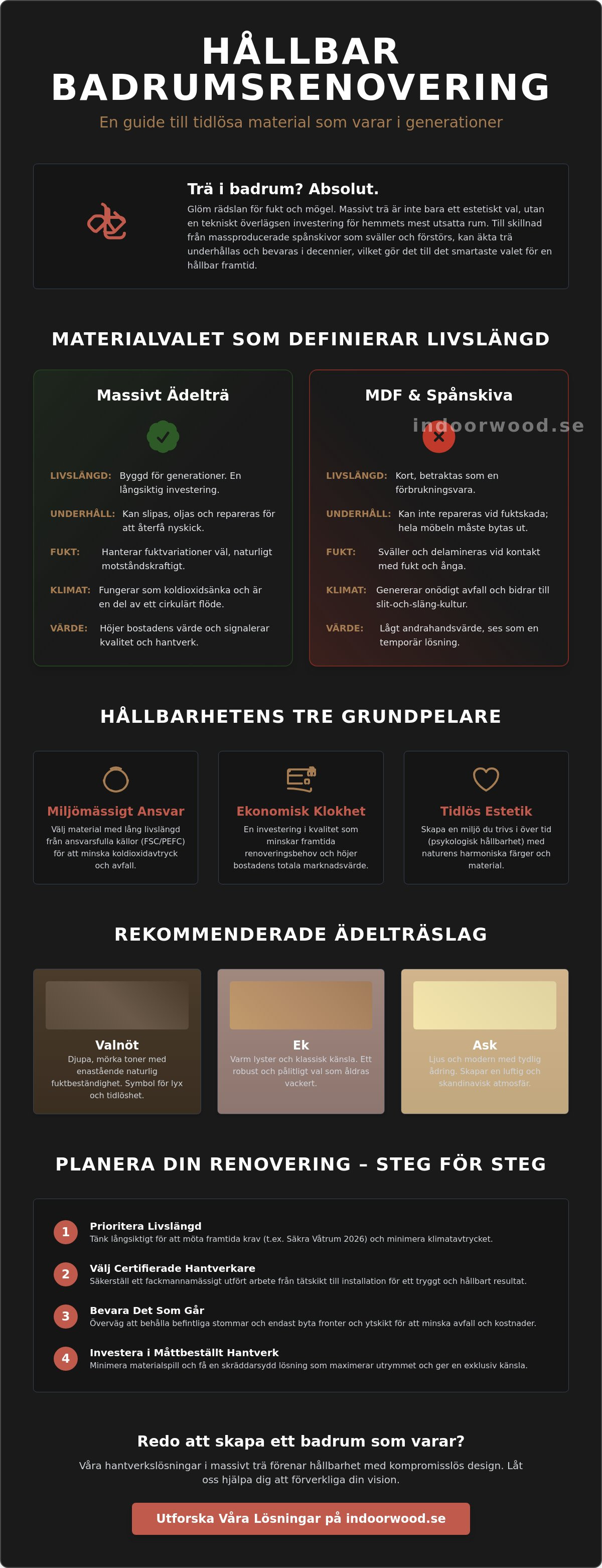
The difference between cheap composite materials and natural stone or hardwood becomes most apparent when we examine their life cycle. Many furniture items sold today consist of foiled MDF or chipboard. When moisture penetrates the joints, the material swells, and the damage is often irreversible. This leads to the entire piece of furniture having to be discarded, creating unnecessary waste. Solid wood reduces the need for future renovations because it can be sanded, oiled, and restored to new condition again and again. From the forest's raw material to the finished vanity, the process is circular in a way that plastic-based materials can never emulate.
Timeless design as a sustainability strategy
Psychological sustainability is a concept often overlooked. It's about creating an environment where you feel as comfortable twenty years from now as you do today. By avoiding short-term trends, you reduce the risk of growing tired of your choice. Nature's own color palette, with the deep tones of walnut or the warm luster of oak, creates a harmonious atmosphere that feels earthy and genuine. Wood as a sustainable material in the bathroom serves as a foundation; it is a base that can be adapted with small changes without the fixed furnishings needing to be replaced. It is simplicity in its most exclusive form.
The best material choices for an environmentally friendly bathroom
Choosing the right material means looking beyond the immediate surface. An environmentally friendly renovation requires a holistic view where every component is examined based on its origin and future. By integrating wood as a sustainable material in the bathroom along with carefully selected natural materials, a balance is created that benefits both the planet and your personal well-being. It's about creating environments that not only look beautiful at the inauguration, but actually become more beautiful with each passing year.
Natural stone and ceramics are often the cornerstones of a bathroom, but their environmental impact differs. Ceramics require large amounts of energy for firing, while the largest footprint of natural stone often lies in transportation. Choosing a local limestone over imported marble from other continents is a concrete way to reduce the project's climate impact. Together with details in brass or stainless steel, materials that are circular heroes thanks to their ability to be recycled endlessly, you lay the foundation for a bathroom with minimal resource waste.
Floors and walls: Stone and ceramics
The choice of color for floors and walls is a strategic decision for the future. By opting for a natural and subdued color palette, you reduce the risk of the bathroom feeling outdated after just a few years. Clay and ceramics are materials with a thousand-year tradition that require very little maintenance. It is a timeless investment that harmonizes perfectly with the warm luster of wood and creates a calm, tactile atmosphere.
Hardwood interiors: Walnut, oak, and ash
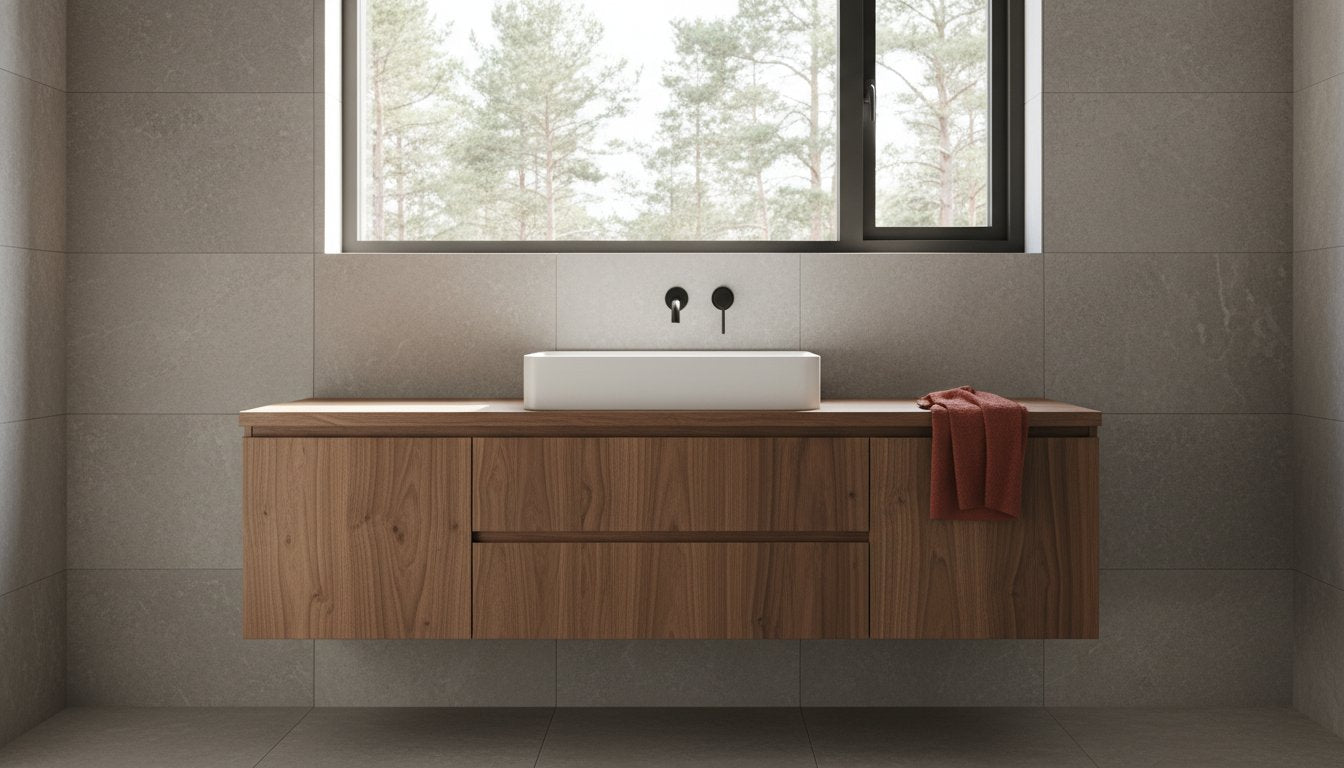
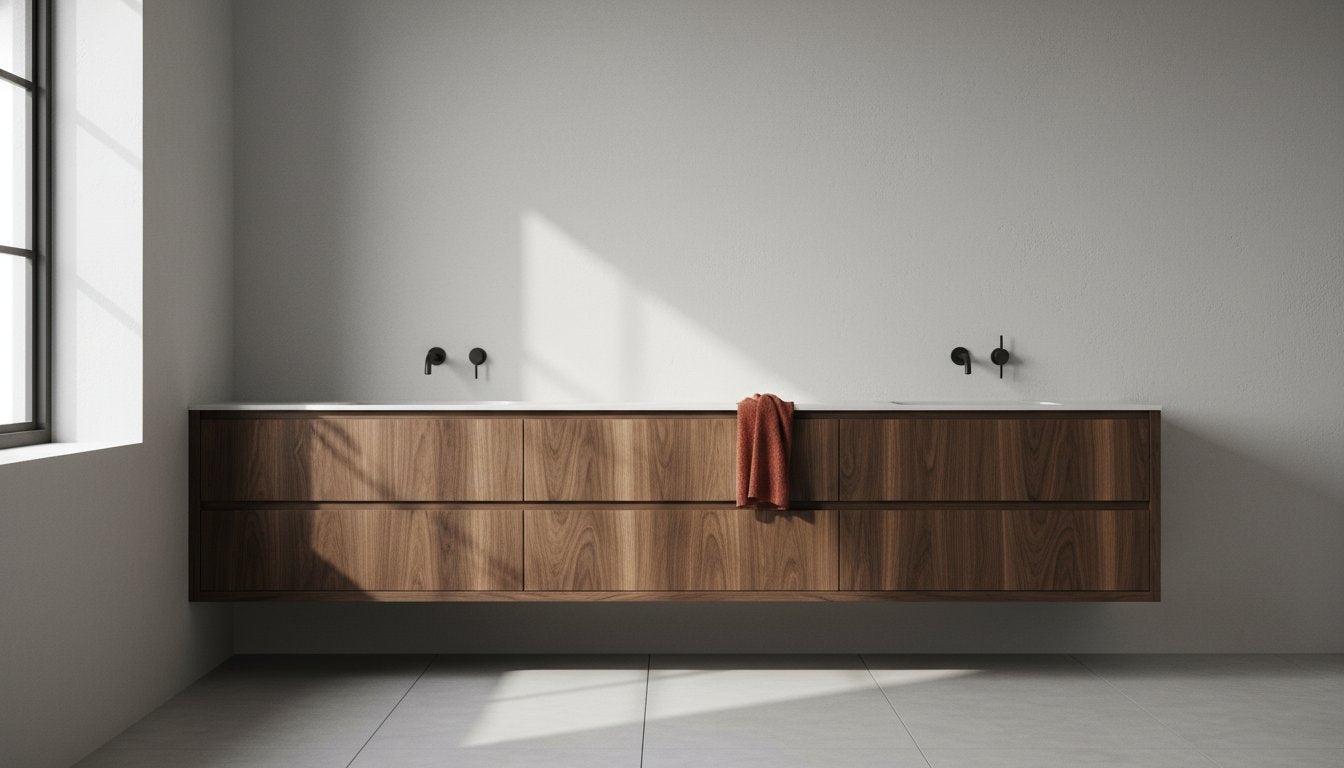
Solid wood acts as a carbon sink directly in your interior. During its growth, the tree has bound carbon dioxide, which is now stored in the furniture instead of burdening the atmosphere. When you choose a walnut bathroom vanity, you are investing in a construction that is technically superior to mass-produced alternatives in MDF. Solid hardwood can withstand the natural movements that occur with moisture variations without cracking or delaminating.
For wood to be considered a truly sustainable resource, it must come from responsible forestry. FSC and PEFC are the most important labels to look for to ensure that the forest is managed with respect for biodiversity. According to technical expertise on from waterproofing to aesthetics, the key to wood's resistance in wet rooms is proper ventilation and surface treatment. By using wood as a sustainable material in the bathroom, you create an environment that exudes quality. If you want to see how solid craftsmanship can transform your home, you can explore our walnut bathroom vanities that are built to last for generations.
Solid wood in the bathroom: An investment in timelessness
Many still see the bathroom as a sterile zone dominated by cold, hard surfaces. There is a persistent myth that moisture and wood are an impossible equation; a misconception that often leads to choosing soulless plastic materials over natural beauty. The truth is that hardwood performs excellently in wet rooms as long as the ventilation is correctly dimensioned and the material is treated with respect for its natural properties. Solid wood in the bathroom has been shown in modern research to have a fantastic ability to handle humidity through its natural cell structure, making it a technically competent choice for the conscious homeowner.
Walnut in this context is one of nature's most impressive gifts. Its unique dimensional stability means it moves minimally with changes in humidity, which is crucial in an environment where temperature fluctuates rapidly. Oak, for its part, has a historical role stretching from Viking shipbuilding to today's modern interiors. Its natural tannin content provides built-in protection against rot. Choosing wood as a sustainable material in the bathroom means embracing a tradition of sustainability that dates back hundreds of years.
Technical precision and craftsmanship
A piece of solid wood furniture requires a construction that allows the material to "breathe". Wood is a living material that expands and contracts. By using techniques such as frameworks and freestanding panels, we can ensure that the furniture retains its shape for decades. When it comes to surface treatment, we often prefer hard wax oil over lacquer. Hard wax oil penetrates deep into the fibers and provides protection that can be spot-repaired if damage occurs. A lacquered surface often requires the entire piece of furniture to be sanded down if the protection is breached, making oil a more long-term and environmentally friendly choice.
Solid wood drawers and frames are not just a matter of aesthetics. They provide a structural integrity that surpasses anything chipboard can offer. If a solid wood drawer starts to stick after thirty years, it can easily be planed; a piece of composite material furniture is usually ready for the recycling center at that point.
Aesthetic warmth in a functional space
The bathroom is often the first room we encounter in the morning and the last before we go to bed. The ability of wood to create a tactile and soft contrast to tiles and porcelain cannot be overstated. It's about creating a sensory experience where the scent, feel, and visual warmth contribute to inner peace. By integrating an acoustic panel as an exclusive design detail, you can also improve the sound environment, transforming the bathroom from a practical dumping ground into a private oasis for rejuvenation. Wood as a sustainable material in the bathroom is thus as much an investment in your quality of life as in the property's intrinsic value.
Plan your renovation: From waterproofing to aesthetics
A well-planned renovation begins long before the first tile is chipped off. It's about evaluating existing elements with a critical eye. Can pipework or frames be preserved? Tearing everything out of habit is rarely the most sustainable approach. By focusing on precision and quality from the start, you reduce the project's total climate footprint. When you choose wood as a sustainable material in the bathroom, you create an environment that is not only beautiful, but also technically sustainable over time.
To succeed with your vision, you should follow a structured process that prioritizes longevity:
- Step 1: Inventory. Preserve functional parts. If pipework meets modern requirements, there's no reason to replace it.
- Step 2: Certified expertise. Choose craftsmen with documented experience. In Sweden, the new Safe Wet Rooms 2026 regulations involve stricter requirements for waterproofing and floor slopes, which demands precision in execution.
- Step 3: Customization. By dimensioning the interior exactly according to the room's conditions, waste of valuable natural resources is minimized.
- Step 4: Quality over quantity. Invest in products designed to be repairable. A solid wood vanity is such an investment.
- Step 5: Maintenance plan. Establish a simple plan for how surfaces and furniture should be cared for. Oiling a wooden surface takes only a few minutes but extends its life by years.
When planning for the future, the choice of interior is central. Feel free to explore our custom bathroom solutions to see how we can help you optimize your space without unnecessary waste.
Choose the right lighting and fixtures
Lighting sets the atmosphere and affects how we perceive the textures of materials. LED technology is now standard for keeping energy consumption down, but sustainability also depends on the quality of the fixture. Invest in faucets with a long warranty period where spare parts such as gaskets and cartridges are available. A timeless design in brass or stainless steel saves natural resources because you never feel the need to replace them for purely aesthetic reasons.
Ventilation and moisture protection
Effective ventilation is the single most important factor in preserving wood as a sustainable material in the bathroom. By rapidly removing steam, both the interior and waterproofing are protected. The new regulations for 2026 emphasize the importance of following the manufacturer's instructions for waterproofing to the letter, especially in Zone 1. By combining modern sensor technology for moisture monitoring with traditional, solid materials, you create a bathroom that is both safe and soulful.
Create your dream bathroom with Indoor Wood
True luxury in the bathroom arises when craftsmanship meets the raw strength of nature. For us at Indoor Wood, wood as a sustainable material in the bathroom is not just one choice among many, but the foundation of everything we create. We believe in furniture that carries a story and has the ability to tell new ones over decades. By choosing interiors built to last, you take clear environmental responsibility without compromising on the aesthetic experience.
Our philosophy rests on the idea of the slow home. By using solid hardwood and entirely avoiding short-term solutions in plastic or MDF, we create interiors that withstand all stages of life. Direct contact with us as manufacturers gives you a transparent value flow and the assurance that every component is selected with the utmost care. When you invest in a solid walnut vanity cabinet or a solid walnut tall cabinet, you are investing in craftsmanship that is free from unnecessary intermediaries and short-term profit interests.
Every bathroom has unique conditions and challenges. We therefore offer custom-made solutions that optimize your space precisely according to your needs, effectively reducing material waste during manufacturing. A custom-made walnut bathroom vanity becomes not just a practical piece of furniture; it becomes the room's architectural anchor that harmonizes with the home's other material choices.
Craftsmanship that makes a difference
We see every knot and grain as proof of authenticity. It is these natural variations that make your furniture unique and give it soul. Our passion for details, from the precision-crafted drawers to the silky smooth finish, guarantees functionality that lasts for generations. Our design thinking also extends far beyond the bathroom walls. You can advantageously explore our kitchen inspiration to see how we create a common thread of solid wood throughout the home, where quality and aesthetics go hand in hand.
Visit our showrooms for personal advice
Nothing can replace the physical experience of real wood. We invite you to our showrooms to let your hands wander over the surfaces and feel the weight and warmth of the material. Here you will receive personal advice tailored to your specific bathroom renovation and your unique measurements. Wood as a sustainable material in the bathroom requires knowledge, and we are here as your advisory partner throughout the process. Book an appointment to discuss custom solutions in walnut, oak, or ash and let us together create a bathroom that ages with dignity.
Invest in a bathroom for the future
A bathroom renovation is one of the most significant projects in a home. By consistently choosing wood as a sustainable material in the bathroom, you create an environment that not only complies with the latest industry regulations for 2026 but also carries a timeless soul. We have seen how solid hardwood, correctly constructed and cared for, surpasses modern composite materials in both longevity and aesthetic value. It's about moving from short-term consumption to a circular mindset where furniture can be sanded, oiled, and cherished for generations.
As a family-owned company with a deep passion for genuine craftsmanship, we deliver the highest quality directly from our own manufacturing, without expensive intermediaries. Our custom-made solutions in exclusive hardwoods are designed to optimize your space and minimize unnecessary waste. Explore our sustainable bathroom furniture in solid walnut and oak and let us help you transform your vision into a reality that smells of nature and quality. Your future bathroom is waiting to take shape with materials that only become more beautiful with each passing year.
Common questions about sustainable bathrooms
What is the most durable material for a bathroom floor?
Natural stone, such as Swedish limestone, or ceramics are the most durable choices for a bathroom floor thanks to their extreme longevity and resilience. These materials resist moisture and heavy wear for decades without losing their function or aesthetic charm. By choosing a timeless color and a material that ages gracefully, you reduce the need for future renovations, which is at the core of an environmentally conscious mindset.
Can you really have a solid wood bathroom vanity without moisture damage?
Yes, it is perfectly fine to use wood as a sustainable material in bathrooms as long as the room has functioning ventilation and the furniture is expertly surface-treated. Solid walnut is particularly suitable thanks to its natural dimensional stability and resistance. A high-quality hard wax oil creates a protective barrier that allows the wood to breathe while preventing water from penetrating the fibers.
How do I know if the wood in my interior is sustainably produced?
You ensure the origin of the wood by checking that the product carries certifications such as FSC or PEFC. These labels guarantee that the raw material comes from responsible forestry that takes into account biodiversity and local ecosystems. Moreover, buying directly from a transparent manufacturer gives you a clear insight into the entire production chain, from forest to finished furniture.
Is it more expensive to choose sustainable materials for a bathroom renovation?
The initial cost of solid natural materials is often higher, but from a life cycle perspective, it is a more economical investment. A hardwood bathroom vanity can be sanded and re-oiled to look new again, while cheaper alternatives made of particleboard often have to be discarded at the slightest moisture damage. This means your investment pays off through reduced replacement needs and a higher resale value for your home.
What certifications should I look for when buying bathroom furnishings?
Primarily look for FSC and PEFC for wood furnishings, as well as documentation showing that the waterproofing system meets the requirements of Säkra Våtrum 2026. It is also wise to examine whether the manufacturer uses environmentally friendly surface treatments, such as hard wax oils without harmful solvents. Quality certifications ensure that your furnishings meet the stringent requirements for durability in moist environments.
How do I maintain a walnut bathroom vanity to make it last?
You maintain your vanity best by wiping away water splashes immediately and periodically re-treating the surface with a nourishing hard wax oil. Avoid strong cleaning agents with acids or abrasives that can damage the wood's natural protection. By using wood as a sustainable material in the bathroom, you get furniture that requires minimal care to maintain its luster and resistance for many decades.
What is the difference between environmentally friendly and sustainable construction?
Environmentally friendly construction focuses on the direct ecological footprint of materials, while sustainable construction also includes economic and aesthetic long-term viability. A sustainable bathroom is an environment where you thrive and can live for 20 to 30 years without feeling the need to renovate again. It's about combining a low climate impact with a quality that can truly withstand the test of time.
Can I combine underfloor heating with solid wood furniture in the bathroom?
It is perfectly fine to combine underfloor heating with solid wood furniture as long as the furniture has a construction that allows for the wood's natural movements. Solid wood reacts to temperature changes by expanding and contracting, but with the right craftsmanship techniques, the heat poses no risk of cracking. The result is instead a pleasant and warm atmosphere that enhances the room's natural feel.