MDF Board: A complete guide to use, benefits, and material selection
Could it be that the secret behind a perfect, custom-built interior is not always solid wood, but rather lies in the technical precision of an MDF board? We understand that material choice often raises doubts, especially when you dream of that silky smooth finish but worry about the surface swelling due to moisture or losing its shape over time. It's natural to want the very best for your home, and the fear of compromising on durability is something every artisan's soul recognizes. It's a balancing act between aesthetics and function that requires both knowledge and intuition to achieve that exclusive final result that transforms a room into a harmonious whole.
In this guide, you will learn everything about the material's properties, from how to choose correctly between standard thicknesses like 12 mm and 19 mm to the secrets behind a professional paint job that gives the surface a mirror-like finish. We give you the tools to understand when fiberboard is actually the technically superior choice over living wood and how to achieve a result that feels both luxurious and solid. We will review how to navigate between the different qualities to find the optimal balance between price and the timeless beauty your next interior design project deserves.
Key Takeaways
- Explore why the homogeneous fiber structure of MDF has become an indispensable favorite for craftsmen striving for perfection in painted interior details.
- Learn to balance the aesthetics between the living grain of solid wood and the dimensionally stable surface of an MDF board to create furniture that lasts over time.
- Discover the secret behind a flawless surface finish and how best to prepare the material for both high-gloss and matte lacquers in your projects.
- Master the craft with the right techniques and tools to minimize chipping and ensure a safe working environment during processing.
- Get guidance through our checklist that helps you prioritize quality and long-term durability when choosing between solid wood and board materials.
What is an MDF board? The basics of Medium Density Fibreboard
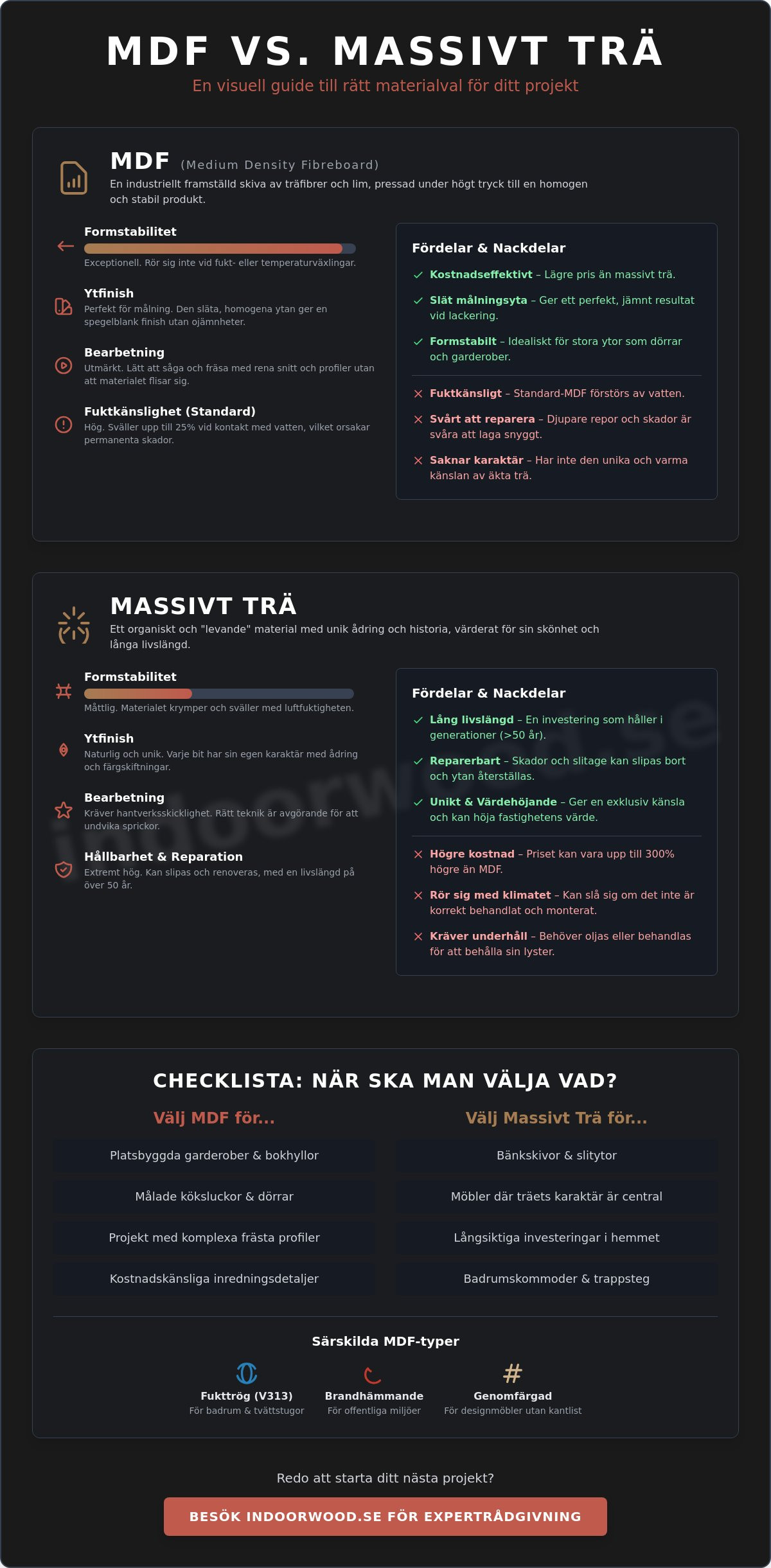
A beautiful home begins with the right foundation, and in modern interior design, the choice of material is crucial for the final result. What is an MDF board? The abbreviation stands for Medium Density Fibreboard, an industrially produced product that has revolutionized the carpentry world. By breaking down softwood into fine fibers, which are then bound together with glue and wax under extreme pressure and heat, a board with outstanding stability is created. Unlike solid wood, the material does not move with temperature changes, making an MDF board the obvious choice for custom-built wardrobes and elegant kitchen cabinet doors.
What truly distinguishes the material is its homogeneous core. Where particleboard often splinters during processing, MDF allows for a precision reminiscent of the finest hardwoods. Carpenters prefer the material for its ability to take on complex shapes through milling without the surface roughing up. The silky smooth surface is optimal for varnishing, as it does not absorb paint in the same uneven way that natural wood can. From the smallest moldings to frames in modern kitchens, the material offers a reliability that combines aesthetics with function.
Technical properties and density
The density of standard MDF is usually between 600 and 800 kg/m³. This density is critical for the board's ability to hold screws and maintain its shape over time. In the Swedish market, the range extends from thin 3 mm back panels to robust 30 mm boards often used for solid tabletops or sturdy shelves. The homogeneous structure allows for profiles to be milled directly into the board's edge with a perfect result, something impossible with particleboard.
Different types of MDF for different needs
Needs vary depending on the room's character. For environments with higher humidity, such as bathrooms or laundry rooms, moisture-resistant MDF, often designated V313, is required. This variant is treated with moisture-resistant glue to withstand swelling in demanding climates. In public environments, fire-retardant variants are used instead, meeting strict safety requirements according to European standards.
For projects where aesthetics and craftsmanship meet in a modern symphony, there is Valchromat. It is a through-colored MDF board where organic dyes are added during the fiber stage. This means the board has the same deep tone all the way through, eliminating the need for edge bands. It is a popular choice for architect-designed furniture where one wants to emphasize the material's raw yet sophisticated texture. By choosing the right type of board, you ensure that your home investment lasts for many decades to come.
MDF vs. Solid wood: An in-depth comparison
The choice between dead and living material defines the final result in every woodworking project. An MDF board offers a technical perfection that natural wood can never achieve on its own. Due to its homogeneous construction, MDF lacks the fibers that cause oak or pine to warp when humidity shifts in our Swedish homes. Where solid wood can shrink or swell several millimeters per meter during a dry winter, the MDF board remains perfectly flat. This dimensional stability makes the material indispensable for large, smooth door surfaces and integrated solutions. However, aesthetics are the materials' biggest differentiator. The MDF surface is quiet and even, a perfect canvas for opaque painting but lacks the soul found in nature's own patterns. Solid wood, on the other hand, carries a history through its growth rings and color variations. A damaged MDF board is difficult to save if moisture has penetrated the core. The material then swells up to 25 percent of its original thickness and loses its structural integrity. Solid wood, however, can be sanded down, re-oiled, and regain its luster generation after generation. Looking ahead to 2026, we see that the investment cost for solid materials often pays off through a higher increase in property value. A custom-built solution in hardwood is considered a permanent craft, while MDF is often seen as a functional but replaceable component. The price difference can be up to 300 percent, but the lifespan of solid materials often extends over 50 years with proper maintenance.When to choose solid wood?
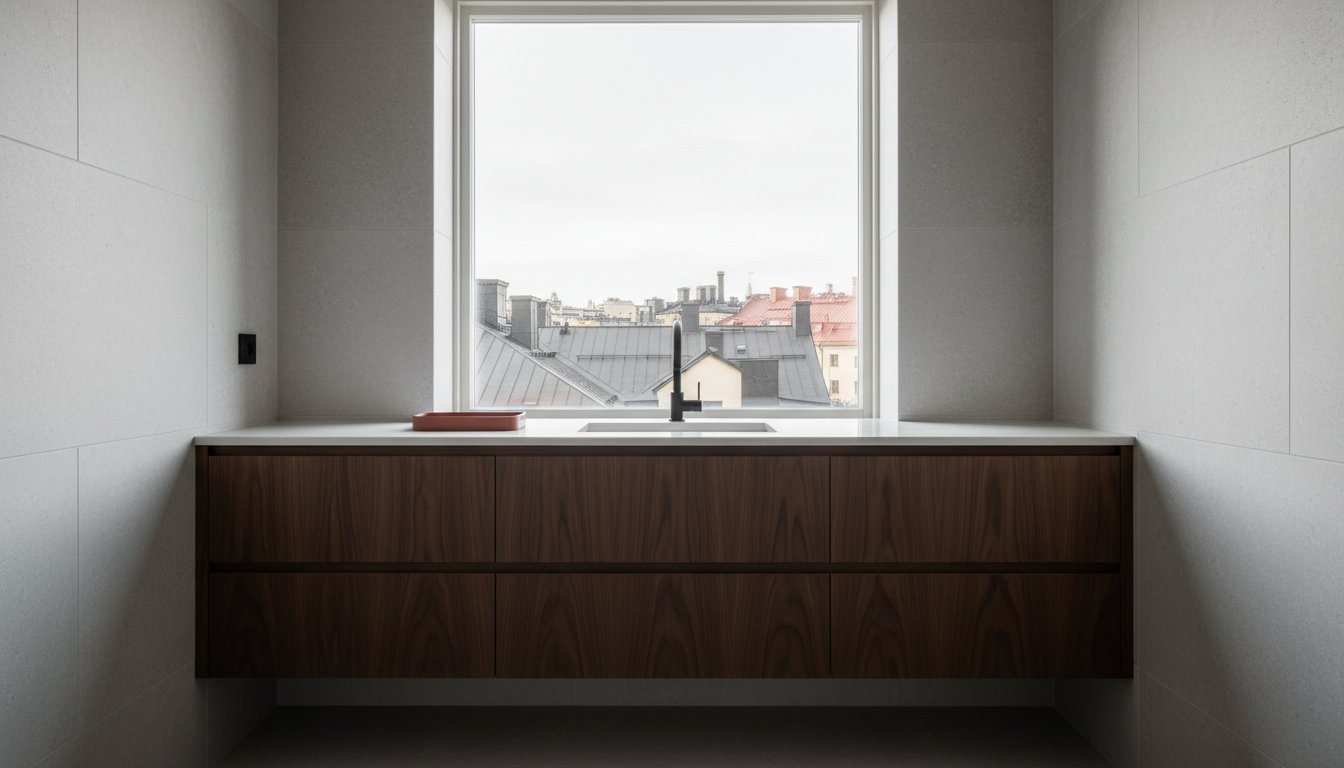
For surfaces exposed to daily wear and tear, such as countertops or stair treads, solid wood is the obvious choice. The organic material contributes to a better indoor climate by regulating moisture and spreading a natural warmth in the room. The tactile experience of a walnut bathroom vanity creates a sense of luxury that a painted surface can never emulate. It is a choice for those who prioritize long-term quality and aesthetic depth.
MDF as a complement in exclusive interiors
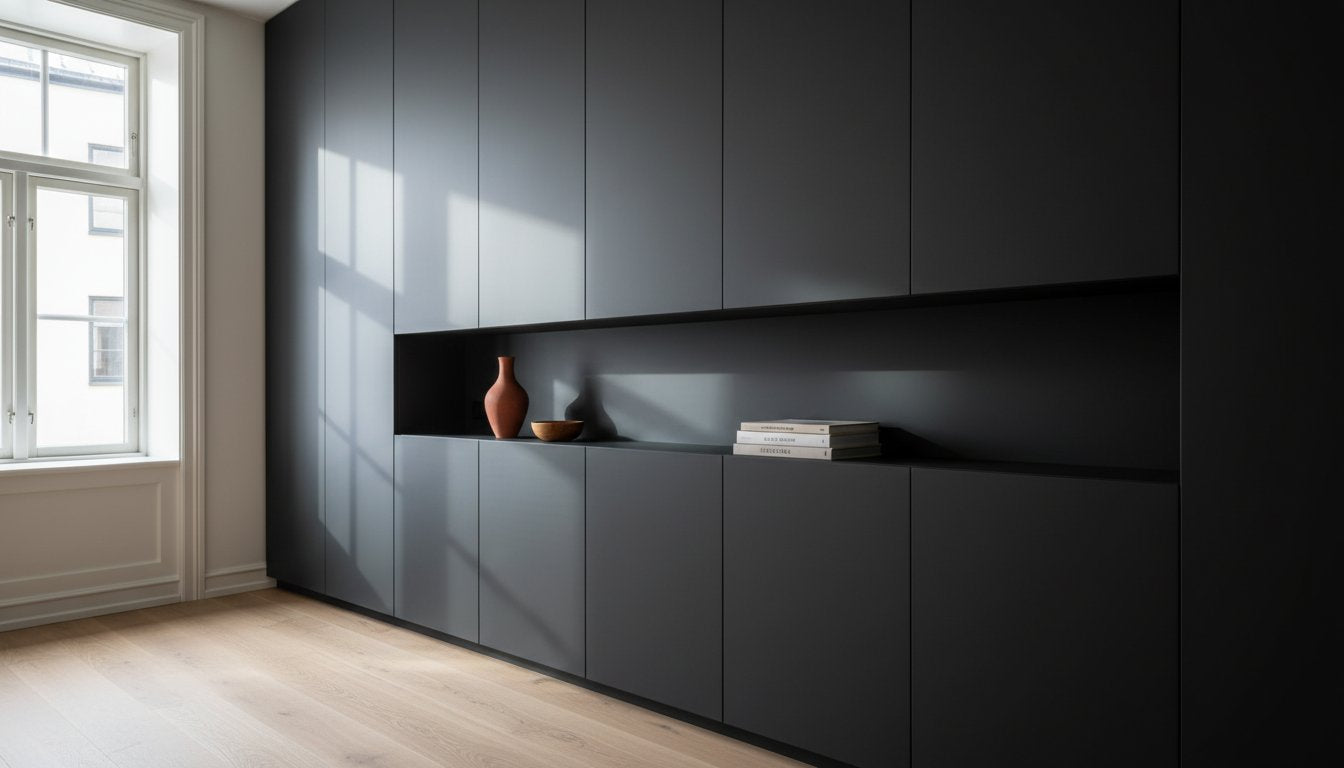
In modern homes, MDF works best as an invisible hero. Architects often use the material for frames or custom-built bookshelves to be painted in the same color as the wall for a seamless look. MDF is also the preferred carrier for exclusive veneer in a wooden kitchen, where one wants to combine the beauty of hardwood with the absolute stability of the frame. By mixing materials, a balance is created between economy and timeless design.
Advantages and disadvantages of MDF in interior design projects
Choosing the right material for an interior design project requires a balance between aesthetics, function, and economy. An MDF board is often the craftsman's first choice when the goal is a perfect, painted finish. The biggest advantage lies in the material's homogeneous structure. Unlike solid wood, MDF lacks knots and grain that can bleed through the paint or create unevenness. This makes the surface optimal for both high-gloss and matte varnishing, where the end result often resembles a factory-finished surface with outstanding precision.
For larger projects, such as custom-built wardrobes or elegant wall panels, MDF is a very cost-effective option. The material is easy to work with and allows for advanced milling of profiles without splintering. However, there are limitations that one should be aware of. MDF is sensitive to moisture. If water penetrates the board, especially at the more porous edges, the material swells rapidly. This process is irreversible and can destroy an otherwise beautiful piece of furniture. Furthermore, the material lacks the natural character and the scent of the forest that solid wood adds to a home. It is a technical material rather than a living one.
- Smooth surface: Provides a seamless result when painting and varnishing.
- Dimensional stability: Does not move in the same way as solid wood with temperature changes.
- Processing: Can be milled and sawn into complex shapes without cracking.
Sustainability and environmental impact
From an environmental perspective, MDF is an interesting product as it is made from recycled wood waste and thinning timber. This creates a circular flow where resources are utilized efficiently. When choosing an MDF board, however, one should be careful to check the adhesives. In Sweden and the EU, E1-classified boards are standard, which guarantees low levels of formaldehyde. Despite its technical strength, an MDF furniture piece rarely becomes a family heirloom. The material's limited lifespan under wear and tear and the difficulty of renovating a damaged core mean that it is often considered a solution for the present rather than for future generations.
Acoustics and sound insulation
MDF plays a central role in modern acoustic solutions thanks to its high density. A standard board often has a density of about 600 to 800 kg per cubic meter, making it effective for dampening vibrations and sound waves. Compared to particleboard or plywood, MDF provides a more rigid construction. This is why the material is widely used as a core in acoustic panels and in constructions where the sound environment is in focus. By combining the board's weight with strategic milling, environments can be created that are both visually appealing and acoustically balanced.
How to work with MDF for best results
Mastering an MDF board means understanding the material's unique density and composition. To achieve a final result that exudes craftsmanship and precision, the right equipment is required from the start. Always use carbide blades for cutting and ripping. Ordinary steel blades wear down after only a few meters due to the board's high glue content and compact structure. A dull blade creates unnecessary friction, resulting in ugly burn marks and splintered edges that require extensive rework.
Safety during processing should never be underestimated. When sawing or routing MDF, microscopic dust is released that can remain in the air for several hours. A respirator with at least class P2 is mandatory to protect your lungs from particles and binders. Always connect an efficient dust extractor directly to your machine; this eliminates up to 92% of the dust directly at the source and maintains a clean working environment.
When assembling, pre-drilling is an absolute requirement, especially near the edges. Since the material lacks natural fibers, it tends to delaminate if a screw is driven directly into it. Use special screws for fiberboards with a thread optimized to grip the dense core without splitting the board. For concealed fastenings, biscuits or dowels work excellently as the glue surface becomes very stable.
Painting MDF – step by step
A perfect finish begins with careful sanding. Use 120 grit for the large surfaces and go up to 180 on the edges to close the pores. Since the end grain of an MDF board is extremely absorbent, a dedicated sealer or a primer with high solids content is required. Prime the edges at least twice and sand lightly between coats. Water-based paints are an environmentally friendly choice for interior joinery, but for a durable kitchen finish, solvent-based lacquers often provide that coveted, mirror-like surface.
Routing and shaping
MDF is the ultimate material for profiling and decorative details. The homogeneous core allows you to mill advanced patterns and designs without worrying about knots or unevenness. To avoid burn marks, keep the router in constant motion and avoid excessively high RPMs. When gluing mitered corners, a fast-setting PVA glue creates a joint that is often stronger than the material itself, ensuring a construction that lasts over time.
Choosing the right material for your project: A summary
Making the decision between an MDF board and solid wood requires an analysis of both the room's character and the furniture's intended lifespan. It's about weighing the silky-smooth, painted surface against the wood's natural grain and tactile warmth. To facilitate your choice, we have compiled a practical checklist that guides you through the material jungle.
- Surface finish: Are you striving for a perfectly smooth, painted surface without visible knots or texture? Then MDF is the obvious choice.
- Durability over time: Should the furniture be able to be sanded and age gracefully for 50 years? Solid wood wins in the long run.
- Budget and scope: For large custom-built projects, such as extensive bookshelves or wardrobe walls, MDF offers the best value for money without compromising on stability.
- Environment and moisture: In environments with varying humidity, stable MDF is often more predictable than living wood that moves.
When planning your investment, it is crucial to prioritize quality over the lowest price. A cheap board with low density, often below 600 kg/m3, risks swelling at the slightest moisture or crumbling when you install fittings. Choosing a high-quality MDF board ensures that screws stay put and that edges remain sharp even after years of use. It's the details that define the final result. By adding carefully selected knobs, you can elevate a simple construction to an exclusive level. It is in the meeting between industrial precision and artisanal tactility that true aesthetics emerge.
Invest in the classics of the future
At Indoor Wood, our hearts beat extra strongly for hardwood, despite the technical advantages of modern composite boards. We see a growing value in genuine craftsmanship and natural materials in an era characterized by digital transience. A plank of oak or walnut carries a history and a unique identity that no machine can copy. These are materials that not only fulfill a function but also create an emotional connection to the home.
However, you don't have to choose sides. The most successful renovation often combines the best of both worlds. By using stable MDF frames for structure and economy, and then crowning the project with solid details, you create a home that feels both modern and timeless. Choosing materials with care is to lay the foundation for a home where quality is felt in every touch, from the floorboards to the cabinet handles.
Give your interior design dream the right foundation
The choice of material shapes the entire room's atmosphere and determines how well your vision endures through the years. An MDF board is often the most rational choice for painted surfaces due to its even density and dimensional stability, but it lacks the inherent warmth that solid wood provides. Understanding when to prioritize the technical advantages of MDF and when to invest in the natural variations of wood is key to a successful result.
We at IndoorWood are a family-owned company with a deep passion for craftsmanship and tradition. In our showrooms in Stockholm and Gothenburg, you get the opportunity to feel the materials and see how our custom-made solutions in walnut, oak, and ash create a unique character in the home. We see every project as a personal commitment where technical precision meets aesthetic intuition to create something that is both durable and timelessly beautiful.
Discover our timeless interior design solutions in solid wood
Let your creativity be guided by the natural strengths of the material, and you will create a home to enjoy for a long time to come.
Common questions about MDF
Does an MDF board withstand water?
A standard MDF board does not withstand direct contact with water and swells quickly if exposed to moisture. For environments with higher humidity, such as bathrooms or laundry rooms, you should instead choose a moisture-resistant variant marked V313. When exposed to moisture, an untreated board can expand by up to 10 percent of its original thickness, which permanently destroys the surface finish.
What is the difference between MDF and particleboard?
The difference lies primarily in the material's density and surface structure, where MDF consists of finely ground wood fibers while particleboard consists of larger wood chips. This means that an MDF board has a significantly smoother surface that is ideal for painting and precision milling of beautiful details. Particleboard is often 15 percent lighter but tends to splinter during processing, making it less suitable for visible joinery.
Do you have to prime MDF?
Yes, you should always prime the material to saturate the absorbent fibers and create an even base for the topcoat. Without a proper primer, the board absorbs paint unevenly, especially along the milled edges which are more porous than the flat surface. By using a dedicated adhesion primer, you ensure that the final color achieves the depth and elegance your craftsmanship deserves.
Is MDF dust dangerous?
Dust from processing is harmful to inhale as it contains extremely fine particles and binder residues. Always use a face mask with a P3 filter and ensure you have efficient dust extraction connected to your machines for every cut. Modern E1 class boards remain below the limit value of 0.124 mg formaldehyde per cubic meter of air, but good ventilation is still crucial for a safe working environment.
What screw should be used in MDF?
Use a screw with a coarse thread specifically designed for fiberboards to prevent the material from splitting. It is absolutely essential to pre-drill the hole with a drill bit that is exactly 1 millimeter narrower than the screw, especially if you are screwing into the short side of the board. Place the screw at least 25 millimeters from the edge to maintain the board's strength and avoid unsightly cracks in your project.
Can MDF be used outdoors?
Standard grades of MDF should never be used outdoors as they absorb atmospheric moisture and break down quickly. There are special products like Medite Tricoya Extreme which are chemically modified to withstand outdoor climates for up to 50 years without rotting. However, for most common outdoor home projects, solid wood or fiber cement is a safer choice to guarantee a timeless and durable result.
How thick MDF is needed for a shelf?
For a shelf with a span of 80 centimeters, a thickness of at least 19 millimeters is required to prevent sagging. If the shelf is to support heavier objects such as books or ceramics, it is wise to go up to 22 or 25 millimeters for extra stability. A 19-millimeter board generally withstands a load of 15 kilograms per running meter without its shape being negatively affected over time.
Is MDF environmentally friendly?
The material is often considered a sustainable choice as it is made from residual products from forestry, such as sawdust and thinning timber. Choose an MDF board that carries FSC certification to be sure that the raw material comes from responsible and controlled forestry. By investing in high-quality boards with low emission values, you create a healthy indoor environment while utilizing nature's resources efficiently.