Design a kitchen: A complete guide to planning your dream wooden kitchen 2026
A solid wood kitchen isn't just a regular renovation; it's a living legacy meant to serve your home for at least 40 years without losing its soul. To design a kitchen yourself can feel like a difficult balancing act between artistic vision and technical precision, where every millimeter actually determines how the room is perceived in everyday life. We understand that the fear of choosing the wrong measurements or missing the golden rules of ergonomics can often stifle creativity, especially when the material is as exclusive and durable as genuine natural materials deserve.
It's perfectly natural to have a deep respect for the process, as the kitchen is the foundation of the home where function meets aesthetics in every move. This guide provides you with the tools to plan a timeless wooden kitchen for 2026 with full control over both craftsmanship and measurement. You'll learn how different types of wood change the light in the room, which standard measurements guarantee an ergonomic daily life, and how to gradually create a sketch that transforms your vision into a concrete drawing. We cover everything from material selection to technical details so you can invest in an environment that breathes quality and calm for a long time to come.
Key Takeaways
- Learn how to conduct a thorough needs analysis to create the perfect balance between aesthetics and function in your home.
- Discover how to design a kitchen with optimal ergonomics by using the work triangle and correct measurements for a smooth daily flow.
- Understand how the choice of solid wood types like oak and walnut affects the room's light and gives the kitchen a unique, timeless character.
- Get practical tips on how to measure with millimeter precision and place appliances to maximize both space and user-friendliness.
- See how custom-made solutions from Indoor Wood can refine your vision into a finished piece of craftsmanship that lasts for generations.
The basics of kitchen design: From vision to first sketch
To design a kitchen is about uniting the heart of the home with technical precision. It's a process where dreams of warm wooden surfaces meet the reality of ergonomic demands and flow. Before you draw the first line, you need to understand that a kitchen is more than just cabinets and doors; it's a workspace that must withstand the test of time and last for generations. Especially when we talk about handcrafted wooden kitchens, a different kind of consideration is required than with mass-produced solutions. Here, we let the natural variations and inherent strength of the material guide the design, creating a unique atmosphere that feels both luxurious and down-to-earth.
The difference between planning for a new build and a renovation is significant. With new construction, you have a blank slate where you can optimize flows from the ground up without limitations. With a renovation in an existing home, you must instead adapt to fixed angles, load-bearing walls, and the house's historical character. It's about respecting the building's soul while modernizing its function for 2026 needs. Designing for wood also means considering how the material moves and how light falls on the natural grain of the joinery.
Inventory your needs and conditions
Before opening a design program, you should examine your daily life and how the room is actually used. How many people move in the kitchen during the morning rush? If there are two of you cooking at the same time, wider aisles and more dedicated work surfaces are required. Identify where water, drainage, and electrical outlets are located. Moving these installations can cost anywhere from SEK 10,000 to over SEK 50,000 depending on the conditions in the property. Create a priority list where you distinguish between absolute necessities and aesthetic desires. To create an efficient flow, it is crucial to start from the ergonomic kitchen triangle, which minimizes unnecessary steps between the sink, stove, and refrigerator.
Choose the right method for your drawing
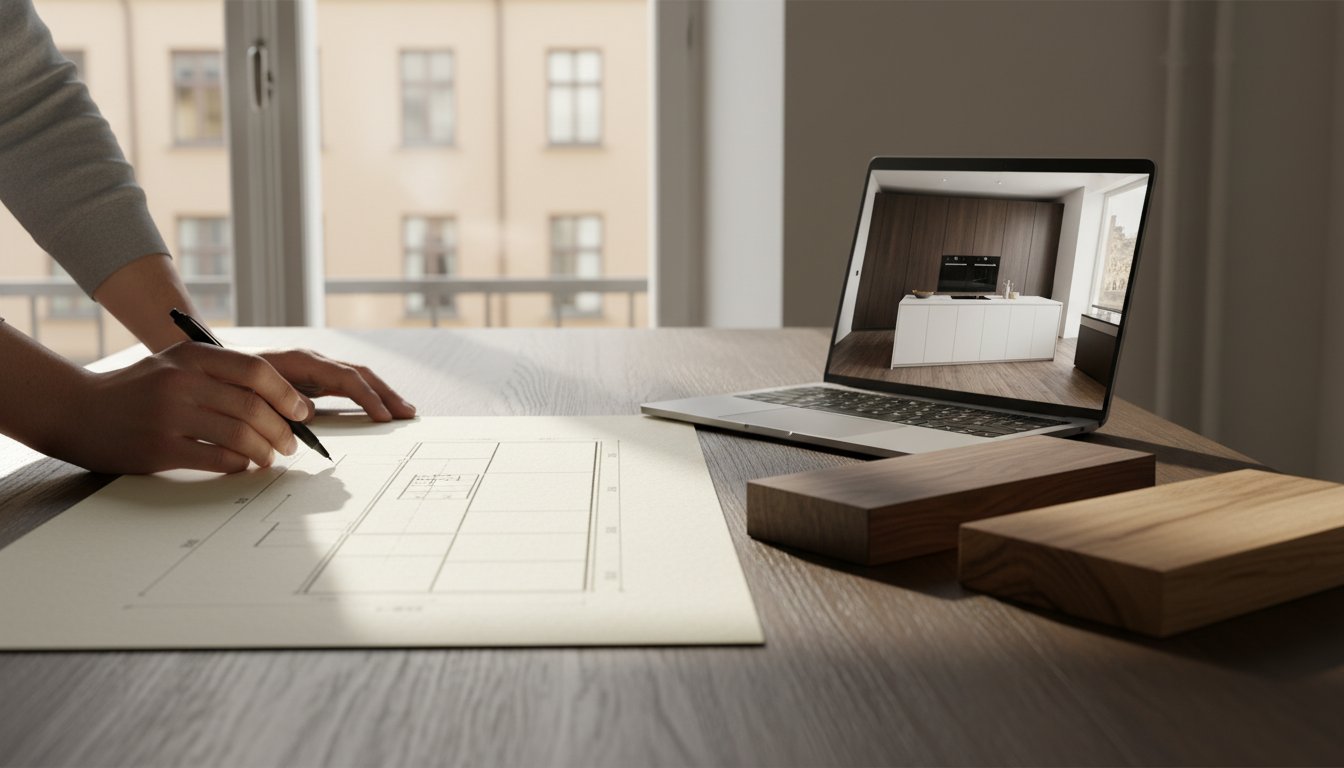
Many start with analog sketches. Graph paper and a pencil offer a creative freedom that digital tools can sometimes limit at an early stage. It allows thoughts to flow freely around material choices and spatial feel. Digital drawing programs, on the other hand, are indispensable when you need to check exact measurements and see the kitchen in 3D. For projects involving solid wood and custom-built solutions, it is often wise to seek professional help early in the process. An expert can identify smart solutions that save both time and money, and ensures that every millimeter of your future kitchen is utilized with the greatest precision.
Ergonomics and standard dimensions: The rules you should not break
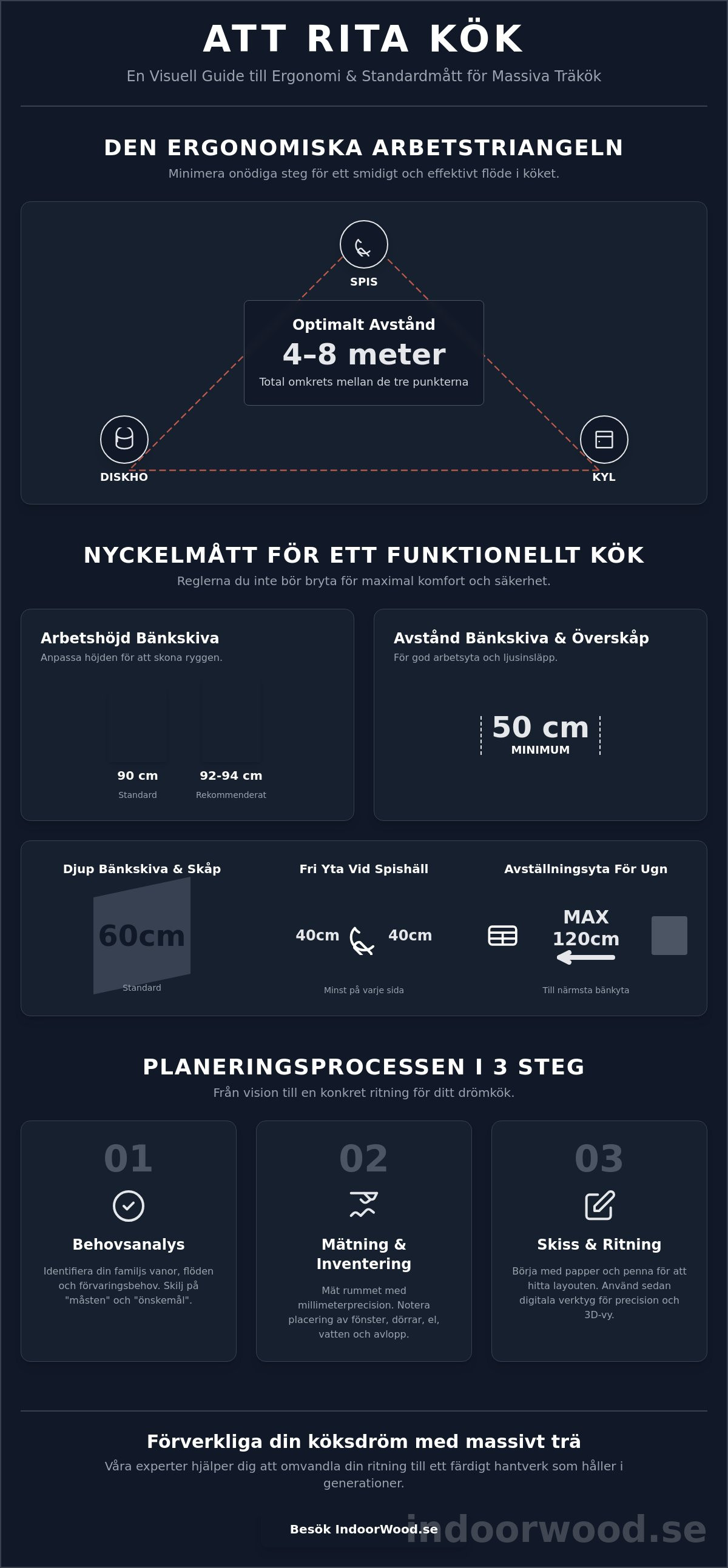
Designing a kitchen involves much more than just choosing beautiful doors and solid wood countertops. It is a technical discipline where every millimeter counts to create a daily life without unnecessary strain. The cornerstone of all kitchen planning is the work triangle. This invisible line connects the three most important points in the kitchen: the refrigerator, the stove, and the sink. For the flow to feel natural, the total distance between these points should be between 4 and 8 meters. If the distance is too short, the kitchen feels cramped; if it's too long, cooking becomes unnecessarily tiring.
Precision in measurements is crucial to achieve that timeless feeling of quality that IndoorWood strives for. The working height is perhaps the most important factor for your long-term health in the kitchen. While 90 cm has long been standard, we see that 92 cm or even 94 cm is becoming increasingly common to protect the backs of taller users. When choosing materials for your countertops, it is wise to look for certifications that ensure the wood comes from responsible sources, for example, through the Forest Stewardship Council (FSC), which guarantees that the beauty of your kitchen does not come at the expense of the environment.
Safety should never be compromised for aesthetics. Around the hob, at least 40 cm of free resting space is required on both sides. This is about being able to put down hot pots quickly and safely. Likewise, the oven should be placed so that there is a natural resting surface in its immediate vicinity, preferably no more than 120 cm away.
The most important measurements to keep track of
The standard depth for countertops and base cabinets is 60 cm. This is a measurement deeply rooted in Swedish building standards and allows appliances to be seamlessly integrated. The distance between the countertop and wall cabinets should be at least 50 cm to ensure a good working angle and sufficient light. For those who want to delve deeper into how volume and ergonomics interact, we recommend reading more about detailed measurements in the kitchen to optimize every square centimeter.
Plan for movement and passage
A common mistake when designing a kitchen is to forget about maneuvering space. A fully open dishwasher door requires approximately 60 cm of free space in front of it. For a person to pass behind someone unloading the dishwasher, a total of 120 cm aisle width is needed. Between a kitchen island and a wall-mounted cabinet row, 110–120 cm is the ideal measurement. We also recommend using pull-out drawers instead of traditional cabinet doors in the base cabinets. This provides an immediate overview and means you don't have to kneel to reach that cast-iron pan that ended up furthest back in the corner.
By respecting these basic rules, you create a foundation of function that allows the natural beauty of the wood to take center stage. If you are unsure about how your specific measurements affect the overall result, you can always consult our experts to ensure that your future kitchen is as ergonomic as it is beautiful.
Design with character: Designing kitchens in solid wood
Designing kitchens with solid wood requires a keen sense of the material's inherent logic and soul. It is a craft where aesthetics meet biology. Each type of wood carries its own story and fundamentally affects the room's atmosphere. A dark walnut absorbs light and creates an intimate, exclusive feel, while a light ash or oak reflects daylight and opens up smaller spaces. When you choose to design a kitchen in these materials, you are investing in something that lives and breathes with your home.
The direction of the grain is a critical detail in the design process that is often overlooked. By allowing the wood's pattern to run horizontally across several drawer fronts, you create an unbroken visual line. This gives the kitchen an architectural calm and a sense of custom-built precision. Wood reaches its full potential when contrasted with cold natural materials. A heavy natural stone countertop or details in brushed metal highlight the warmth of the wood and create a balanced material palette that feels both modern and timeless.
Wood is a living material that reacts to shifts in humidity. When planning for 2026, we see an increased emphasis on technical precision, where margins are incorporated for the wood's natural movements. This is about understanding that the material expands and contracts; an insight that ensures the construction lasts for generations without warping or cracking.
Walnut, oak or ash – what expression are you looking for?
The choice of wood defines the entire personality of the kitchen. Walnut is the choice for those seeking a luxurious and warm atmosphere. Its deep, dark tones create a dramatic backdrop that feels both cozy and sophisticated. Oak remains the Scandinavian classic due to its exceptional durability and timeless expression. It is a material that withstands everyday wear and tear and only becomes more beautiful with age. To deepen your understanding of the material, you can learn more about solid wood and its unique technical properties before making your final decision.
The details that complete the whole
When you are going to design a kitchen, it is the small details that determine whether the end result feels solid. By choosing kitchen doors that emphasize the natural structure of the wood, you create a tactile experience every time you touch a surface. An oak countertop is an excellent choice for creating visual harmony and a cohesive feel between work surfaces and cabinets. To truly bring out the luster of the wood, you should plan for integrated lighting. Hidden LED strips that cast a soft grazing light over the wood grain highlight the depth of the material and create an atmosphere that no other material can emulate.
- Walnut: Provides a warm, dark, and luxurious feel.
- Oak: Timeless Scandinavian design with maximum durability.
- Ash: A light and lively option that gives space to smaller kitchens.
- Lighting: Use warm white light (2700K) to enhance the natural color tones of the wood.
Step-by-step: How to create your kitchen drawing
Transforming visions into a concrete drawing requires both patience and technical precision. When you want to design a kitchen yourself, the journey begins with a tape measure in hand. It is here, in the methodical measuring, that the foundation for successful craftsmanship is laid. Millimeter precision is not a suggestion; it is a requirement for the exclusive wooden modules to fit perfectly against the walls.
Start by measuring all dimensions of the room. Measure the length of the walls at three different heights to identify if the walls are sloping. Mark out window frames, door casings, and existing water connections directly on your sketch. Once the shell is complete, it's time to place the kitchen's engines. The sink, stove, and refrigerator form the classic work triangle and should be placed first to optimize the movement pattern.
- Measure the room: Include fixed obstacles such as radiators and pipe runs.
- Prioritize appliances: Place the refrigerator, freezer, and dishwasher to create a logical flow.
- Plan storage: Fill in the gaps with base cabinets and drawers. Drawers often provide 30 percent better overview than deep cabinets.
- Create space: Use open shelves in oak or ash to break up heavy cabinet walls.
- Final check: Verify that all drawers can be pulled out completely without hitting door casings or handles.
From rough sketch to detailed plan
Work in a 1:20 scale to get a fair representation of the proportions. This means that 5 centimeters on paper corresponds to 1 meter in reality. Use ready-made templates for standard 60-centimeter modules to quickly test different layouts. Don't forget to draw in electrical outlets and switches early. A common mistake is to place outlets too late, which can force compromises in the beautiful wood paneling or backsplash.
Visualize in 3D
When you choose to design a kitchen digitally, you get the opportunity to see volumes in a whole new way. Use simple online tools to understand how the light from the windows affects the natural color variations of the wood throughout the day. Evaluate sightlines carefully. What is the first thing the eye meets when you enter the room? A beautiful solid wood kitchen island can serve as a visual anchor point that elevates the entire home.
Every detail in your drawing is a promise of future quality of life. By being meticulous in the planning phase, you reduce the risk of costly adjustments during assembly. Let your new kitchen rest on a foundation of quality by choosing a timeless wooden floor from IndoorWood that harmonizes with your new decor.
Realize your drawing with Indoor Wood's expertise
Taking the step from drawing a kitchen on paper to actually installing the final details in your home is a journey that requires both technical knowledge and a feel for the material. Indoor Wood acts as your extended arm in this process. We ensure that the visions you've created on screen or sketchpad are translated into physical components with millimeter precision. By choosing a custom-made solution, you avoid compromising with cover panels and filler pieces that often disrupt the aesthetic flow of a standard kitchen. Each module is adapted to the unique conditions of the room, maximizing both storage and work surfaces in a way that mass-produced carcasses can never achieve.
Our process is based on an unbroken chain without expensive intermediaries. This means we have full control over the entire flow, from when the timber is selected until the finished joinery is delivered to your door. Investing in a kitchen from Indoor Wood is more than just a renovation; it's a long-term increase in the value of your property. Solid natural materials are often seen as one of the most profitable investments in a home, as they age with dignity and can be sanded or refinished instead of being discarded after ten years.
Personal advice for your dream kitchen
Once you have started designing your kitchen and have a basic idea of the layout, we invite you to an in-depth dialogue with our experts. During a personal meeting, we will review your sketches to identify opportunities and technical solutions that can further enhance the result. We will help you fine-tune the measurements so that each cabinet and drawer feels natural in its placement. To ensure you feel confident in your choices, we are happy to send you samples of different wood types and surface treatments. This gives you the chance to experience the texture and see how the light in your specific room interacts with oak, ash, or walnut before production begins in the workshop.
Sustainability and craftsmanship in focus
Solid wood is nature's own marvel and the most sustainable choice for the conscious consumer. Unlike simple particleboards that contain large amounts of glue and plastics, our kitchens are built from living materials that breathe and contribute to a better indoor climate. Indoor Wood's philosophy rests on craftsmanship that spans generations. We create solutions that not only follow 2026 trends, but also withstand the wear and tear of everyday life for decades to come. Every knot and grain tells a unique story, making your kitchen a personal expression that cannot be copied. It is this combination of traditional knowledge and modern precision that creates a home with genuine character.
Realize your vision of timeless craftsmanship
Creating a kitchen is about balancing technical precision with a genuine feel for the material. By prioritizing ergonomic standard dimensions and sustainable flows, you lay the foundation for a seamless daily life. In 2026, we see solid wood reclaiming its place as the undeniable centerpiece of the home, where every grain in oak and walnut tells a unique story. When you choose to design a kitchen with a focus on quality, you are not just investing in decor, but in a living environment that becomes more beautiful with each passing year.
We at Indoor Wood specialize in exclusive walnut and oak, and we are passionate about transforming your initial sketches into a finished masterpiece. Our custom-made solutions are fully adapted to your home's architecture and your personal needs. By working directly with us as manufacturers, you gain access to world-class craftsmanship at the best market price, completely without intermediaries. Your dream of a solid wood kitchen is just a call away.
Let us help you design your dream kitchen in solid wood – Contact Indoor Wood today
We look forward to exploring the endless possibilities of wood with you and creating a space where you can truly settle in.
Frequently asked questions about planning and designing kitchens
Which design program is best for designing a kitchen yourself?
The most accessible tool for drawing kitchens yourself is IKEA's planning tool, but for a more bespoke feel in wood, SketchUp or Roomle are recommended. According to industry statistics from 2024, 65 percent of home planners use web-based free programs for their initial sketches. These tools allow you to visualize material choices and layout in 3D before the first plank is cut. This provides reassurance that the design harmonizes with the house's other wooden details and architecture.
How do I measure my kitchen correctly before planning?
Precision begins with a laser measurer with a margin of error of less than 2 millimeters to ensure accurate dimensions. Measure the ceiling height in three different places, as floors and ceilings are rarely perfectly parallel, especially in older properties. Note all fixed installations such as water pipes, electrical outlets, and ventilation placement with exact measurements from the nearest corner. Don't forget to account for window and door frame depths when designing a kitchen to avoid collisions with drawers.
What are the most common mistakes when designing a kitchen?
The most common mistake is ignoring the work triangle between the stove, sink, and refrigerator, which can increase steps in the kitchen by up to 30 percent. Many also forget to plan for filler strips at corners, causing drawers to hit handles or door frames when opening. Make sure to leave at least 50 millimeters of space at wall ends to ensure all fronts can open completely without obstruction. Designing a kitchen requires considering these small but critical margins.
Can I design a kitchen with unusual dimensions and angles?
Yes, custom-built wooden kitchens are the optimal solution for rooms with sloped ceilings or angles that deviate from the standard 90 degrees. By using millimeter-adapted modules, you can utilize 100 percent of the available space instead of hiding voids behind wide cover panels. This is particularly valuable in historic buildings where every square meter is unique. It requires a craftsman's delicate touch to create a solution that feels both natural and exclusive.
How much does it cost to get help with a kitchen design?
The price for a professional kitchen design from an independent architect or kitchen designer usually ranges between SEK 5,000 and SEK 15,000 for a medium-sized project. However, many specialized wooden kitchen manufacturers include the design work in the quote if you choose to order their craftsmanship. An investment in a correct design reduces the risk of expensive installation errors that can cost over SEK 20,000 to fix afterward. It's a solid insurance for a successful end result.
Which dimensions are most important for a kitchen island?
For a kitchen island to feel airy and functional, at least 1,200 millimeters of free movement space is required around all sides. A standard island should be at least 900 millimeters deep if you want seating on the back, providing 300 millimeters for legroom. These dimensions ensure that two people can pass each other without problems. This creates a harmonious flow dynamic in the heart of the home where the warm surface of the wood invites social interaction.
How do I plan the lighting in my kitchen design?
Divide the lighting into three layers, focusing on functional task lighting over countertops, where 500 lux is the industry standard for good visibility. Add ambient lighting that highlights the wood's grain and texture, preferably with dimmable LED strips hidden under upper cabinets or in the plinth. Finally, you should include accent lighting in glass cabinets or over the kitchen island to create depth. This provides a warm atmosphere as darkness falls and transforms the kitchen into a room for relaxation.
Should I choose drawers or cabinets in my design?
Drawers are the superior choice for base cabinets because they offer a complete overview and better ergonomics than traditional shelves. Studies show that pull-out drawers utilize storage volume up to 90 percent more efficiently than deep cabinets where items are often forgotten at the back. Choose solid wood drawers with dovetail joints to combine modern function with the timeless feel of genuine craftsmanship. It's an investment in quality that lasts for generations.