Kitchen Countertops: A Complete Guide to Choosing, Care, and Design 2026
What if the countertop you choose today is not just a practical work surface, but an investment that actually becomes more beautiful with each passing year? The choice of kitchen countertops is one of the most crucial decisions in a renovation, as the surface often accounts for between 10 and 20 percent of the total budget. It's easy to be drawn to wood's warm luster and natural grain, but we understand that concerns about future moisture damage and stubborn stains can often create unnecessary hesitation about the material.
You are absolutely right that a solid wood countertop demands respect, but with the right knowledge, maintenance transforms from a burden into a simple and rewarding craft. In this guide, you'll learn everything about how to choose between timeless oak, exclusive walnut, or Scandinavian ash to create a sustainable and harmonious home. We'll go through the latest function-based building regulations from Boverket (the Swedish National Board of Housing, Building and Planning) that came into full force on July 1, 2026; we'll show you how to care for the surface so that it ages with dignity, and give you the tools to create a kitchen where the presence of nature is felt in every touch.
Key Takeaways
- Learn to navigate between exclusive walnut and timeless oak to find the wood type that best reflects your personal style and the unique character of your kitchen.
- Get concrete tips on how to care for your kitchen countertops to protect them from moisture and stains without compromising the wood's lively texture.
- Discover how to analyze your lifestyle to choose a surface that balances passionate cooking with high aesthetic demands.
- Explore how to create visual harmony by combining solid wood with the right lighting and complementary natural materials.
- Understand the importance of methodical initial treatment to ensure your investment ages with dignity and retains its luster for generations.
What you should know about kitchen countertops before choosing
The kitchen is the beating heart of the home, and at its center, the countertop stands as the absolute protagonist. When planning new kitchen countertops, we often forget that the surface must not only withstand the intense wear and tear of everyday life but also serve as the aesthetic anchor of the room. To understand the basics, one can start by asking: What is a kitchen countertop? In its most fundamental form, it is a horizontal work surface designed to withstand both knife edges and spills. For us at Indoor Wood, however, it represents something much larger; it is an extension of nature and proof of solid craftsmanship.
Choosing natural materials like solid wood creates an atmosphere that no artificial material can replicate. There is an inherent honesty in the wood's grain that gives the room character and soul. From an environmental perspective, wood is also one of the most responsible choices you can make. As a renewable material, it binds carbon dioxide throughout its lifespan, making it a sustainable investment in an era where we value long-term solutions over quick trends. The difference from veneer or laminate is vast; where veneer has only a thin layer of wood and laminate consists of plastic-treated paper, the solid slab is genuine all the way through.
Solid wood vs. other materials
The choice between different materials ultimately comes down to how you want your investment to age. A laminate countertop is admittedly budget-friendly, with prices starting from a few hundred kronor per linear meter, but it can never be repaired once damaged. A solid wood countertop, on the other hand, has the unique advantage that it can be sanded and re-oiled, giving it an eternal life. If we compare wood with stone or composite, we see a clear contrast in the experience. Stone is durable but often perceived as cold and hard. Wood, instead, invites touch with its natural warmth, transforming the kitchen from a sterile production site into an inviting room for socializing.
Function meets aesthetics in the modern kitchen
In today's homes, where open-plan solutions often make the kitchen part of the living room, the choice of material plays a crucial role in room acoustics. The porous structure of wood absorbs sound waves instead of reflecting them, creating a significantly calmer sound environment. According to the new function-based building regulations from Boverket that came into full force on July 1, 2026, the focus is on achieving specific functions rather than following rigid templates. This means you have greater freedom to design your work surface, but it also places higher demands on precision when ordering custom sizes.
Standard depths typically range around 60 cm and working heights around 90 cm, but details make the difference. Increasing the thickness of your wooden slab from 30 mm to 40 mm can give the entire kitchen a more exclusive and stable impression, even if it statistically may increase the cost of the material by between 30 and 50 percent. It is these trade-offs between the dreamy and the concrete that determine whether your countertop becomes a temporary solution or a cherished part of your home for generations.
Comparison of wood types: Walnut, oak or ash for the countertop?
Choosing the right wood type for your kitchen countertops is about more than just aesthetics; it's about understanding the soul of the material and how it will interact with your life. Each wooden plank carries a unique story told through its grain and color variations. Wood is a living material that matures over time. Through a process called patination, the nuances change as the wood is exposed to daylight and daily use. For an investment that often costs between 9,000 and 18,000 Swedish kronor for a standard solution of 3 to 4 linear meters, it is important to choose a material that you want to grow old with.
The elegance of walnut in the kitchen
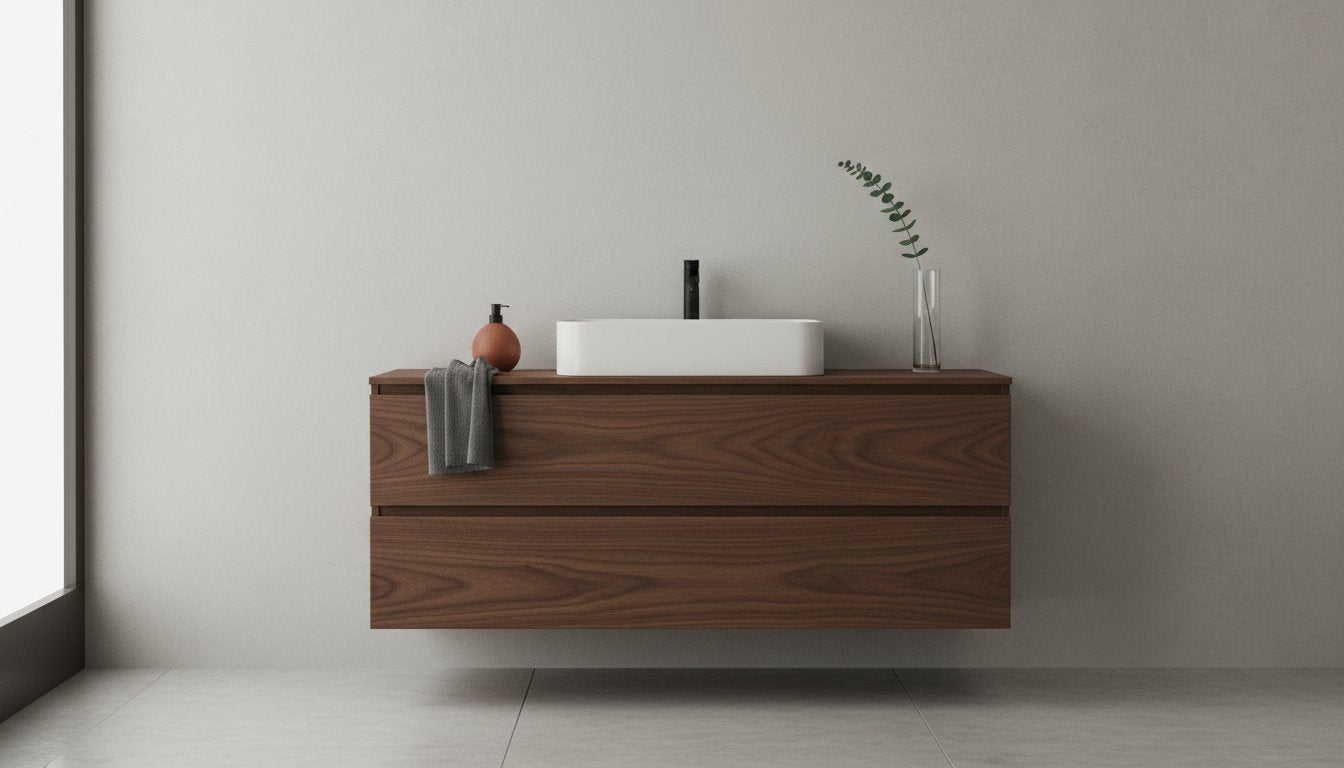
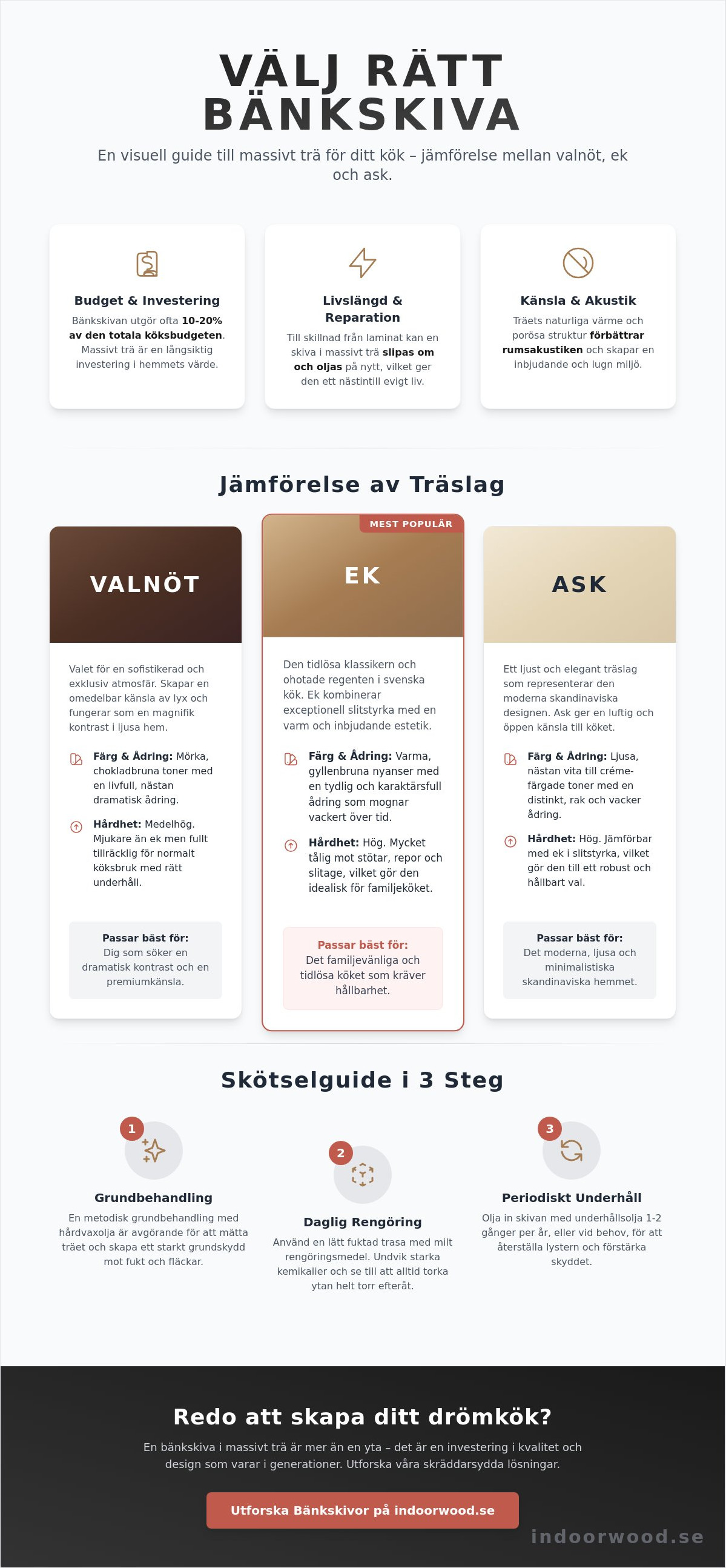
Walnut is the choice for those seeking a sophisticated and exclusive atmosphere. Its dark, chocolate-brown tones and lively, almost dramatic grain create an immediate sense of luxury. In a bright Scandinavian home, walnut acts as a magnificent contrast point that grounds the decor. To create a harmonious whole in the home, many choose to echo the material in other rooms, for example, through a walnut bathroom vanity. Technically, walnut is slightly softer than oak, but its density is perfectly sufficient to handle the demands of the kitchen if treated with care.
The bright Nordic expression of oak and ash
Oak has long been the unchallenged ruler in Swedish kitchens, and there are good reasons for this. It is a timeless classic that combines extreme durability with a warm, golden tone. If you want an even brighter and more modern expression, ash is a fantastic alternative. Ash's clear structure and light surface have a unique ability to open up and brighten even smaller kitchens.
When comparing the durability of materials, we often use the Brinell scale, which measures the hardness of wood:
- Ash: Approximately 4.0 Brinell. One of our hardest native hardwoods, perfect for the active cook.
- Oak: Approximately 3.7 Brinell. The gold standard for durability and stability.
- Walnut: Approximately 3.4 Brinell. Slightly more forgiving, requiring a little extra vigilance against impact damage.
Regardless of whether you fall for the depth of walnut or the freshness of ash, it is important to remember that the character of the wood only becomes more beautiful with age. It is a surface that lives with you. If you want to explore how these materials feel in reality, you can order samples to see how the light in your particular kitchen falls across the different wood types.
Step-by-step: How to choose the right countertop for your lifestyle
Investing in new kitchen countertops is a journey that begins with self-awareness rather than color swatches. Are you someone who loves baking sourdough bread directly on the wooden surface, or do you primarily see the kitchen as a place for aesthetic recovery and peaceful mornings? A countertop often accounts for between 10 and 20 percent of your total kitchen budget. This makes the choice one of the most strategic points in your renovation. By purchasing your slab online, you can also save between 20 and 40 percent compared to traditional kitchen stores. You can then advantageously invest these savings in a more exclusive wood type or a more advanced surface treatment that elevates the entire room.
The choice of surface treatment is crucial for both feel and function. Classic oil deeply saturates the wood fibers and brings out the natural warmth, but it requires more regular maintenance. Hardwax oil creates a more resistant surface that effectively withstands spills and stains. For those seeking that soft, silky feel so characteristic of the Scandinavian heritage, a traditional soap treatment might be the way to go. It's a choice that requires commitment, but rewards you with a surface that feels amazing to the touch.
Needs analysis for the active family
For the active family, we recommend harder wood types such as ash or oak. These materials withstand the bumps and knocks of everyday life with a completely different resilience than softer alternatives. If you are planning an undermount sink, precision in craftsmanship is absolutely crucial to avoid moisture damage in the end grain of the wood. A tip for creating visual and technical uniformity is to choose both wooden kitchen and countertop from the same supplier. This ensures that the shades harmonize and that the materials react similarly to the room's natural humidity.
Technical details for custom orders
Precision is not just an aesthetic matter; it is a prerequisite for long-term function. Since the new function-based regulations from Boverket came into full force on July 1, 2026, there is a greater responsibility to ensure that the installation follows industry recommendations to avoid water damage. According to Säker Vatten's latest guidelines for 2026, the requirement that the dishwasher shut-off must be above the counter has been removed. It can now be easily accessible in the cabinet under the sink. This provides a cleaner and more minimalist surface on your kitchen countertops without compromising safety.
When measuring, it is critical to allow space for the natural movements of the wood. Wood is a living material that expands and contracts depending on the season and humidity. At corners and joints, it is therefore important to use the correct mounting brackets that allow for this movement. The choice of edge profile – whether it should be strictly straight, softly rounded, or elegantly chamfered – sets the final, decisive touch on the kitchen's character and how light falls across the wood's surface.
Care Guide: How to make your solid wood countertop last for generations
A solid wood countertop is not a static product that is finished the moment it is installed. It is the beginning of a lifelong relationship between you and the material. For your kitchen countertops to maintain their resistance and luster, a conscious care strategy is required, starting from day one. Wood breathes. It reacts to its surroundings. By understanding the needs of the wood, you transform maintenance from a chore into a rewarding part of home care. Leave strong cleaning agents in the cleaning cupboard; they dry out the wood fibers and break down the natural protection.
The initial treatment during installation is absolutely crucial for the future of the slab. You should thoroughly saturate the wood by oiling the surface weekly during the first few weeks after the slab is in place. Once the wood has stabilized, a monthly treatment for the first six months is often sufficient. Thereafter, when the surface feels saturated and secure, a thorough oiling twice a year is usually enough to maintain protection against moisture and stains.
The ultimate oiling process
When choosing oil, food safety is your highest priority. Use a high-quality oil approved for surfaces in contact with food. Apply the oil evenly with a lint-free cloth and let it soak in for about 20 minutes. If some areas absorb the oil faster than others, apply more there. Then carefully wipe off any excess. An easy way to tell if your kitchen countertops need more care is the water test: pour a drop of water on the surface. If the water forms a bead, the protection is intact. If it is absorbed by the wood, it's time for a new treatment.
Handling everyday accidents
Despite the utmost care, accidents can happen. Water rings from glasses or dark stains from spilled wine don't have to be permanent catastrophes. One of the greatest advantages of solid wood is that the surface can be sanded locally. Use fine sandpaper, preferably with grit size 180 to 240, and sand gently in the direction of the grain until the stain is gone. Then immediately re-oil the sanded area to restore protection. The same methodology applies to other wooden details in the home. Just as when you care for your wooden boxes for durable storage, it's about ensuring the material is never left dry or unprotected.
If, after many years of use, the entire surface has become scratched or worn, you can re-sand the entire countertop to restore it to new condition. This unique property makes wood superior to materials like laminate or stone, which often have to be completely replaced in the event of serious damage. To ensure your investment maintains the highest quality, we recommend using professional products; you can find the right oil for your countertop here to ensure a perfect result.
Design your dream kitchen with natural material countertops
Designing a kitchen is about creating a balance between function and a visual narrative that reflects who you are. Your kitchen countertops serve as the horizontal anchor of the room and set the tone for the entire atmosphere. To create a truly cohesive feel, you can advantageously let the wood extend up the walls. By matching your countertop with an acoustic panel in the same wood type, you create a visual symphony that is not only beautiful to behold but also radically improves the room's sound environment. It is in these encounters between different surfaces that the true magic of interior design arises.
Lighting plays a crucial role in how the natural structure of wood is perceived. Well-placed accent lighting under upper cabinets can transform a seemingly smooth surface into a living landscape of grains and character. In 2026, we see a clear trend where we dare to mix materials more freely than before. The combination of warm wood and cool metals creates exciting contrasts. A few details in brushed brass or blackened steel against a deep walnut slab give a sense of modern luxury that still feels grounded. Don't forget the smallest components of the decor; the right choice of knobs can be the detail that connects the countertop's aesthetics with the character of the cabinet doors.
Scandinavian minimalism
In the modern Scandinavian kitchen, we strive for calm and purity. Here, solid wood acts as a softener against stark, minimalist kitchen modules. The trend for 2026 is moving towards warmer and more earthy tones such as sand, clay, and muted green shades, which harmonize perfectly with the natural palette of ash and oak. In open-plan solutions, where the kitchen and living room merge, the countertop becomes a piece of furniture in itself. By choosing organic, rounded shapes for corners and kitchen islands, you create a flow in the room that feels both inviting and timeless.
The craftsmanship that adds a touch of gold
A custom-made and precisely manufactured countertop is more than just a work surface; it is a piece of craftsmanship that enhances the value of your entire home. When every joint is invisible and every edge profile is sanded to perfection, a sense of care is conveyed that machine-made alternatives can never achieve. It's about choosing a partner who has a deep respect for the raw material and understands how to best highlight the uniqueness of each wooden plank.
At Indoor Wood, we believe in solutions that last over time, both aesthetically and functionally. Every project is treated with the utmost dedication to ensure that the end result is as exclusive as you dream of. Are you ready to take the next step in your kitchen journey? You are warmly welcome to explore Indoor Wood and our range of custom-made countertops to find the material that will form the heart of your future kitchen.
Create a timeless heart in your home
The choice of kitchen countertops is the foundation for a room where life and aesthetics meet in perfect harmony. We have seen how the right choice of wood, from the Nordic lightness of ash to the sophisticated depth of walnut, defines the kitchen's character for decades to come. By following the updated industry regulations from 2026 and saturating the wood with methodical care, you ensure that your work surface not only withstands everyday spills but also ages with unique dignity. It is a long-term investment that combines practical craftsmanship with the dreamy vision of a natural home.
As a family-owned company with a deep passion for the material, we at Indoor Wood deliver our products directly from the manufacturer without intermediaries to guarantee the highest quality in every detail. We specialize in walnut, oak, and ash and guide you through every step, from the initial measurement to the final, protective oiling. Design your unique wooden kitchen with our solid wood countertops and experience the difference of a material that lives and breathes with you. Let nature's timeless beauty become the foundation that transforms your kitchen into the most beloved place in your home.
Frequently asked questions about kitchen countertops
How often do I need to oil my kitchen countertop?
A new countertop should be oiled once a week for the first few weeks, then once a month for the first six months, and finally twice a year. This schedule ensures that the wood remains saturated and resistant to moisture. Use the water test to check if the surface still beads, which is a clear sign that the protection is intact and the wood is in good condition.
Which type of wood is most durable for a countertop?
Ash and oak are the most durable options thanks to their high density and natural strength. Ash has a Brinell value of approximately 4.0, while oak is around 3.7, making them very resistant to impact and scratches. These hard woods are particularly suitable for kitchen countertops in households where cooking is intensive and surfaces are exposed to daily wear and tear for a long time.
Can you have an undermount sink in a wooden countertop?
Yes, it is perfectly possible to have an undermount sink, but it requires absolute precision during installation to avoid future problems. It is critical that the end grain around the sink is meticulously sealed to prevent moisture from penetrating and causing discoloration or cracks. Professional installers often use specially adapted sealants that comply with the latest industry standards from 2026 to ensure a waterproof and aesthetically pleasing solution.
How do I remove stains from a solid wood countertop?
Minor stains and scratches are most easily removed by carefully sanding the surface with fine sandpaper of grit 180 to 240. Always sand in the direction of the wood grain to avoid damaging the natural fibers of the material. After sanding, the treated area must be immediately re-oiled to restore the surface protection and prevent new dirt from penetrating the open wood.
Are wooden countertops hygienic in a kitchen environment?
Wood is a very hygienic material thanks to its natural antibacterial properties, which have been proven in several studies. The pores of the wood absorb bacteria and render them harmless through a natural drying process, making it a safe choice for food preparation. For optimal hygiene, however, it is important to keep the surface saturated with oil so that liquids and food residues cannot penetrate deeply.
What does a custom-made solid walnut countertop cost?
The cost of solid wood countertops generally ranges between 9,000 and 18,000 SEK for a standard solution of 3 to 4 linear meters including installation. Walnut belongs to the higher price segment due to its exclusivity and the wood's slow growth. By buying directly from manufacturers online, you can often reduce the total cost by between 20 and 40 percent compared to shopping in traditional kitchen stores.
Can I install the countertop myself or do I need a professional?
It is possible to install the countertop yourself, but with the new function-based building regulations from Boverket (the Swedish National Board of Housing, Building and Planning) that came into force in 2026, professional help is often recommended. Especially when installing sinks and faucets, it is important to follow Säker Vatten's guidelines for insurance coverage to be fully valid. A professional has the experience required to handle the natural movements of the wood and ensure completely sealed joints.
What is the difference between oil and hardwax oil for kitchen countertops?
The difference lies in how the material protects the wood; regular oil penetrates deep into the fibers while hardwax oil creates a protective film on the surface. Hardwax oil provides stronger protection against liquids and spills for a longer period but can feel somewhat more lacquered in its finish. The choice depends on whether you prioritize the tactile, natural feel of the wood or maximum resistance for your kitchen countertops.